
How To Write An Animated Video Script For An Explainer Video
Table of Contents
This explainer video guide will teach you how to write an animated video script that will help you increase sales and grow your business.
When you start making an animated explainer video, it is important to take the time to write a strong script for your video because it is the framework from which your animated video will be created. Everything from the voiceover to the visual style will be informed by the decisions that are made during the script writing process. This explainer video guide will teach you Video Igniter’s tips, tricks and best practices for writing a script that will help deliver results for your sales and marketing.

If you have a question about animated video scripts that isn’t answered in this article, you can use our contact form to ask your question or click the image below to schedule a call with a member of our production team:

Before you start writing your animated video script…
Before you even begin formulating the concept for your video script, here are a few points we ask our clients to think through (and preferably write down!):
1). What is the goal for this video?
2). Who is this video for?
3). What is the core message you want to convey? Or what is the process to get to success?
4). Why should people care?

Download Video Igniter’s Free Script Writing Template
1). What is the goal for this video?
Start by being concrete about what action you want people to take when they’ve finished watching your video. Do you want them to sign up for a free account? Should they contact you for more information? Or download your app? Whatever that thing is you want your audience to do to move one step down the funnel towards a relationship with your company, be concrete about what that goal is and then use the whole video to illustrate why it’s in the best interest of your target audience to do that thing.

2). Who is this video for?
Being specific about who your target audience is very helpful because it informs what you say and how you should say it. If everyone is your target audience, you’re going to have a more challenging time creating a compelling message that applies to everyone. On the other hand, the more you can connect with the way your target audience talks, the more effective your video will be.
We’ve created hundreds of animated explainer videos for tech companies and we always want to know whether or not we’re creating a video for a ‘technical’ audience. If it is a technical audience, we’ll spend more time illustrating the process and the details for how a new system works. If the audience for that tech product/service is going to be purchased by someone who is less technologically savvy, then we’ll ease off the technical mumbo-jumbo and focus more on the value and benefits the service will bring about if it gets implemented.

Knowing who your specific audience is enables you to make informed decisions during the writing process because you’re able to speak directly to what resonates with them. If your company sells in multiple industries, you should consider creating different versions of your explainer video that specifically illustrate the ways you serve the problems of each industry.
3). What is the core message that should be conveyed in your animated video’s script?
It sounds obvious that you should know what you want to say in your video – after all, it is about your company/product/service. But if you don’t take the time to consider what’s really important to say in your video, there’s going to be a temptation to want to cram in as many details as possible – and that is going to clutter and distract from the parts of your message that are important.
Before you start writing your script, be specific about what key talking points need to be conveyed in the video so that you can prioritize those messages when drafting your script. In fact, we recommend you actually write them down and not keep them in your head so that you can see what key details you actually committed to before you started writing your video script.

How many words are in a 60 second script? The target is 150 words for a video that’s 1 minute long (meaning every word counts!) Focus the story of your script around these main points (2-3 are good for a 1 minute video). Anything that doesn’t support the narrative around these main talking points should be cut out so that you don’t detract from the main purpose of the video.

Aim for 125-150 when writing the script for a 60-second video.
4). Why should people care?
So far, it’s all been about me in this creative exercise: how do I benefit. As you go through the script writing process, everything must be written from the perspective of your target audience – speak directly to what matters to them. You can make a good video that talks about how awesome you are, but your video will be more effective if you focus on your audience’s problems and how you can solve them to make their lives better.
Animated Video Script Structure
Now that you’ve documented the key details, here is how you should structure and organize your explainer video outline:
1). What is the problem
2). What is the solution
3). How does it help / what is the process to get success?
4). What should interested people do next?

Script Writing Time
When you’re ready to write your explainer video script, don’t worry about getting it right the first time. Just follow this video script template, get your ideas on paper and come back later to refine them and make them more cohesive.
1). Introduce the problem
What is a real problem or pain point that your target audience experiences and how can you creatively illustrate that idea in a way that uniquely resonates with them? A lot of explainer video scripts start with the words, “Meet Bob…” and then go on to talk about how Bob works in <insert corporate department here> within a big company and he has this problem. This explainer video structure works because it’s simple and straightforward, but you have a bigger opportunity to connect with your target audience if you can create a unique visual scenario to illustrate their problem.

What problem does your target audience experience?
While you are writing the script for the introduction, think about how you can tell a visual story or create a visual metaphor that illustrates the nature of the problem your audience experiences, rather than just saying, “Bob hates importing contacts into his CRM.”
For a 60 second explainer video, introducing the problem typically takes about 10 seconds or roughly 25 words.
| ~# of Seconds | Approximate Word Count | |
| 30 Second Video | 5 | 13 |
| 60 Second Video | 10 | 25 |
| 90 Second Video | 15 | 37 |
2). Introduce the solution (your product or service)
Here’s the moment where your company/product/service gets to shine – but don’t come on too strong like you’re an advertisement. Your product or service gets introduced to the scenario from the introduction and is presented as a solution to improve the status quo. When your product/service gets introduced, magic happens and your target audience gets the first clue that the big pain in their life or their job can be remedied.

Introduce the solution in your animated video script.
For a 60 second explainer video, the introduction of the solution typically lasts 10 seconds or about 25 words.
| ~# of Seconds | Approximate Word Count | |
| 30 Second Video | 5 | 13 |
| 60 Second Video | 10 | 25 |
| 90 Second Video | 15 | 37 |
3). How does it help / what is the process to get to success?
Remember when I said to be clear about what your main talking points are? Well this is the area to bring those details into your explainer video script. It’s now your job to paint a picture of how your solution improves the scenario through it’s unique value and benefits. Many companies say their product/service can “Save you time and money” – instead, you should use animation as a unique way to show a visual story about the way your product/service enables someone to save time and money.

Your animated video script should show how you are going to help save time and money for your clients.
Time-pending, we recommend you use this part of the video script to talk about your top 3 talking points. Don’t just tell people, show them 3 ways you make their life better. You get about 10 seconds for each talking point. In some cases, particularly for videos about tech products with a tech-savvy target audience, it makes more sense to spend this part of the video explaining the exact process that helps the target audience accomplish something new – how do they get from where they were to where they could be.
For a 60 second explainer video, the main section of your video typically lasts 30 seconds or about 75 words.
| ~# of Seconds | Approximate Word Count | |
| 30 Second Video | 10 | 25 |
| 60 Second Video | 30 | 75 |
| 90 Second Video | 45 | 112 |
4). What should interested people do next?
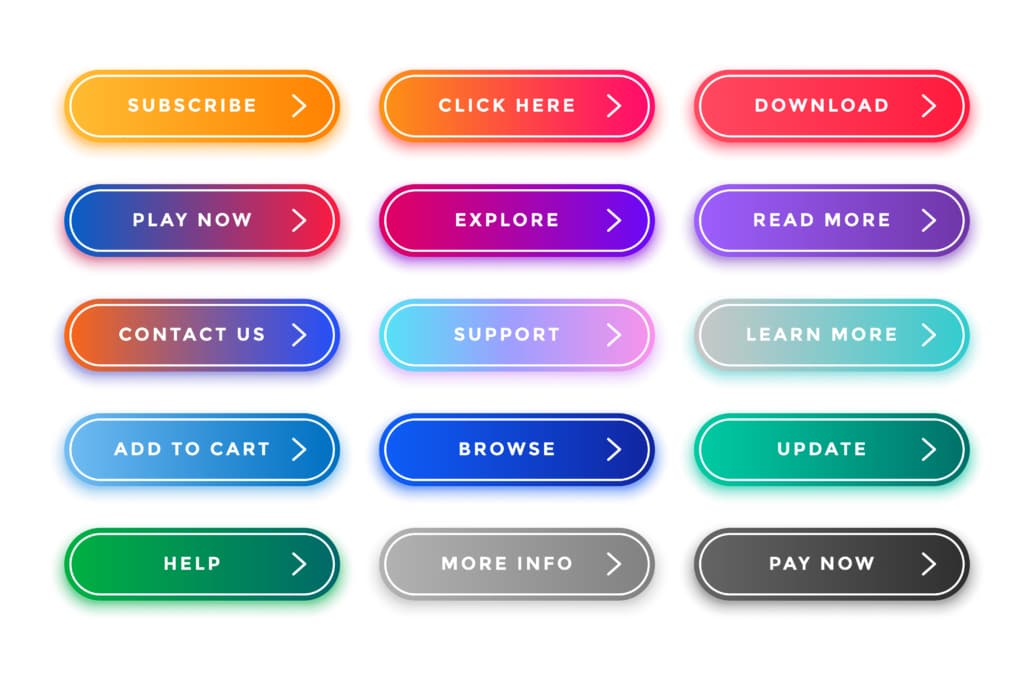
Examples of popular CTAs for your explainer video.
Here’s where you take it all home. Summarize how life can be better for your target audience and how they take the first step to making that part of their life. Typical CTAs include signing up for a free account, contacting a sales rep, and downloading an app.
For a 60 second explainer video, the CTA section typically lasts 10 seconds or about 25 words.
| ~# of Seconds | Approximate Word Count | |
| 30 second video | 10 | 25 |
| 60 second video | 10 | 25 |
| 90 second video | 15 | 37 |
This is a tried and true animated video script template for crafting a narrative that gets people interested in learning more about your product/service/organization. For more tips and tricks to revise and improve your script, check out our article called: Supercharge Your Animated Video Script Writing.
Animated Video Script Examples
Want to see examples of animated video scripts and the videos they were turned into? Check out this guide to learn all about animated explainer video scripts and how to write explainer video scripts.
Common Mistakes to Avoid When Writing an Animated Video Script

Even with a strong structure, many businesses make common mistakes that weaken their animated video script. Avoid these pitfalls to ensure your video is clear, engaging, and results-driven:
Being Too Vague: A compelling animated video script should focus on specific benefits, not just general statements. Instead of saying, “Our software makes work easier,” explain exactly how it saves time or streamlines processes.
Overloading with Information: Your audience doesn’t need every detail—stick to 2-3 key points in your animated video script to keep it focused.
Ignoring Storytelling: A successful animated video script should tell a story, not just list features. Weave a relatable problem, solution, and transformation into your video.
Lack of a Clear Call to Action: Your animated video script should end with a strong CTA, guiding viewers on what to do next—whether it’s signing up, requesting a demo, or visiting your website.
How to Make Your Animated Video Script More Engaging

An effective animated video script captures attention and keeps viewers engaged from start to finish. Here’s how to make yours stand out:
Use Conversational Language: Your animated video script should feel like a natural conversation with your audience—avoid jargon and overly complex language.
Incorporate Humor or Emotion: People remember videos that make them feel something. Adding humor or a heartfelt story to your animated video script can make it more memorable.
Add a Hook in the First 5 Seconds: The first few seconds of your animated video script are crucial. Start with a question, an interesting fact, or a relatable problem to keep viewers watching.
Use a Unique Perspective: Your animated video script should differentiate your message from competitors. A fresh angle—such as a creative character-driven story—can make your video more compelling.
Deep Dive: For more tips to make your animated videos script more engaging, read our companion article about “How To Improve Your Animated Video Script Writing.”
Choosing the Right Voiceover Style for Your Animated Video Script

The voiceover brings your animated video script to life. Choosing the right voice ensures your message resonates with your target audience. Consider these factors:
Casual vs. Formal Tone: A casual tone in your animated video script may work well for startups or lifestyle brands, while a formal tone is better suited for finance or legal industries.
Energetic vs. Calm Delivery: The tone of your animated video script should match your product and audience. An upbeat, high-energy voice may be great for tech startups, while a calm, reassuring tone works for healthcare or insurance videos.
Male vs. Female Voiceover: Both can be effective, but it’s worth A/B testing different voiceovers to see what resonates best with your audience. Choose a voice that complements your animated video script and brand identity.
Visual Storytelling: How to Align Animation with Your Animated Video Script

Your animated video script should seamlessly translate into visuals. Here’s a few tips to ensure your script is animation-friendly:
Write with Visuals in Mind: As you draft your animated video script, consider how each scene will be visually represented. Animation allows for creative storytelling, so leverage it!
Use Metaphors and Analogies: An animated video script can simplify complex concepts using visual metaphors. For example, showing a rocket launch to symbolize business growth.
Ensure Pacing Matches the Script: Each line of your animated video script should align with smooth transitions and animations. A well-paced video ensures that viewers absorb the key message without feeling rushed.
How to Format an Animated Video Script

Knowing what to say is only half the process of writing an effective animated video script. You also need to organize the script in a format that makes it easy for a voiceover artist, storyboard artist, animator, and client to understand exactly what should happen in each scene.
A professional animated video script usually contains more than just narration. At minimum, each section should identify:
- Scene number: Helps everyone on the production team keep track of the video.
- Voiceover: The exact words the narrator or character will say.
- Visual direction: A description of what the audience should see while the voiceover is being delivered.
- On-screen text: Any headlines, statistics, labels, captions, or other text that appears on screen.
- Sound effects or music: Optional notes about important audio cues.
- Timing: An estimate of how many seconds the scene should occupy.
For example, an animated video script could be formatted like this:
Scene 1 — The Problem | 0:00–0:08
Voiceover:
“Managing customer data shouldn’t require your team to spend hours jumping between spreadsheets.”
Visual:
Show an overwhelmed employee surrounded by spreadsheets and browser windows. The screens begin multiplying until the character can barely see over them.
On-screen text:
“Too much data. Too many spreadsheets.”
Sound:
Fast-paced typing and notification sounds.
This format gives the animation team something much more useful than a paragraph of marketing copy. It establishes the relationship between the words and the visuals before production begins.
Why You Should Write the Visuals Into Your Animated Video Script

One of the most common mistakes when writing an animated video script is treating the script like a piece of website copy.
A website can explain something with several paragraphs of text. An animated video has a limited amount of time and can communicate information through movement, characters, graphics, diagrams, transitions, and visual metaphors.
That means you should ask a simple question about every major sentence:
“What will the audience see while they hear this?”
If you cannot think of an interesting visual for a sentence, the sentence may need to be rewritten.
For example, consider this line:
“Our platform provides businesses with a comprehensive solution for improving operational efficiency.”
It sounds professional, but it gives an animator very little to work with.
A more visual version might be:
“Instead of switching between five different tools, your team can manage everything from one place.”
Now the animator has an obvious opportunity: show a character switching between multiple applications before bringing everything together inside a single platform.
The second version is easier to understand, easier to visualize, and more natural to hear in a voiceover.
Write an Animated Video Script for the Ear, Not the Page

A video script is meant to be heard.
This sounds obvious, but many scripts are written as though they are intended to be read silently. That can result in long sentences, complicated terminology, awkward transitions, and language that sounds unnatural when spoken aloud.
After writing your first draft, read the entire animated video script out loud.
If you find yourself running out of breath, stumbling over a sentence, or wanting to rephrase something while speaking, that’s a good indication that the script needs editing.
Use shorter sentences. Choose familiar words. Remove unnecessary qualifiers. Write the way an intelligent person would actually speak to another person.
For example:
Written-style version:
“Our innovative platform enables organizations to efficiently streamline their workflow management processes while simultaneously improving collaboration between team members.”
Voiceover-friendly version:
“Our platform helps your team manage workflows, stay organized, and work better together.”
The second version contains less information, but it communicates the idea faster and is considerably easier to listen to.
Avoid Writing One Sentence Per Animation
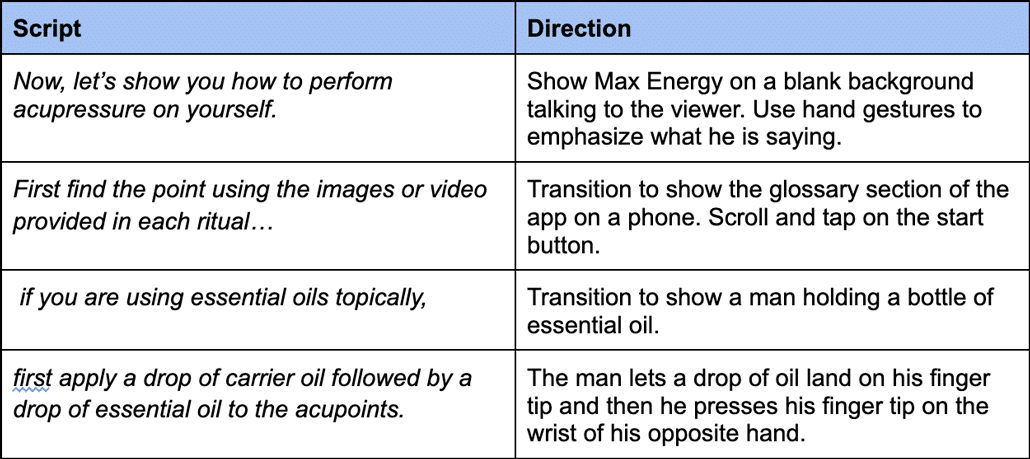
Your animated video script should not attempt to describe every movement an animator will make.
You do not need to write:
“Character raises right hand, moves hand toward computer, clicks button, computer screen changes, character smiles, camera zooms into screen…”
That level of direction can unnecessarily restrict the animator and make the script difficult to read.
Instead, describe the intended visual idea:
“Show the character using the platform to complete the task. The interface becomes simpler as unnecessary steps disappear.”
This gives the creative team enough information to understand the concept while leaving room for them to determine the best way to animate it.
How to Write a Strong Hook for an Animated Video

The opening of your animated video script has an important job: give viewers a reason to continue watching.
Your hook does not necessarily need to be shocking or humorous. It simply needs to establish relevance quickly.
Some effective approaches include:
Start With a Problem
“Still spending hours every week manually entering customer data?”
This works because it immediately identifies a problem experienced by the intended audience.
Start With a Question
“What would your team accomplish if you got five extra hours every week?”
A question can encourage viewers to mentally participate in the story.
Start With an Unexpected Statement
“Most companies aren’t losing customers because their products are bad.”
This creates curiosity because the viewer wants to know what the actual problem is.
Start With a Visual Situation
Animation gives you an advantage that live-action video does not always have: you can immediately create an exaggerated visual scenario.
For example, instead of beginning with:
“Managing projects can be difficult.”
You could show a project manager attempting to keep dozens of spinning plates in the air while notifications, emails, spreadsheets, and deadlines pile up around them.
The voiceover can then say:
“Keeping a project on track shouldn’t feel like a circus act.”
The visual and verbal hooks reinforce each other.
Add Proof to Your Animated Video Script

Many explainer videos explain the problem and introduce a solution but never answer the viewer’s next question:
“Why should I believe you?”
Adding proof can make an animated video script more persuasive.
Depending on your business, proof could include:
- A customer result
- A statistic
- A testimonial
- The number of customers served
- Years of experience
- A recognizable customer or partner
- A before-and-after comparison
- A specific performance improvement
- An industry certification
- A demonstration of the product itself
For example, instead of saying:
“Our software saves businesses time.”
Consider:
“Teams using our platform have cut their weekly reporting time from five hours to less than one.”
The second statement is more specific and gives the audience something concrete to remember.
Be careful not to add statistics simply because statistics sound impressive. Every claim in your script should be accurate and supportable. A specific, credible result is more useful than a vague collection of impressive-sounding numbers.
Use Benefits Instead of Listing Features

A feature tells the viewer what your product does. A benefit explains why the viewer should care.
For example:
Feature:
“Automated reporting.”
Benefit:
“Get your weekly report without spending Friday afternoon building it.”
The benefit is more relatable because it connects the product to a real-world outcome.
A useful way to develop your animated video script is to create a simple feature-to-benefit table before writing:
|
Feature |
Immediate Benefit |
Bigger Outcome |
|
Automated reports |
Less manual work |
Your team gets time back |
|
Centralized data |
Information is easier to find |
Fewer mistakes and delays |
|
Real-time notifications |
Problems are identified sooner |
Projects stay on schedule |
This exercise can help you determine which features actually deserve space in a short animated video.
The “One Video, One Main Idea” Rule

One of the hardest decisions in animated video script writing is deciding what not to include.
A company may have dozens of features, several target audiences, multiple differentiators, and years of history it wants to communicate. A 60- or 90-second video cannot effectively explain all of them.
Instead, identify the single idea you want viewers to remember after the video ends.
For example:
Too broad:
“Our platform helps businesses manage sales, marketing, customer service, accounting, projects, analytics, and communication.”
More focused:
“Your sales team can finally see every customer interaction in one place.”
The second message gives the video a clear purpose.
If you have several important messages, consider creating a series of shorter animated videos rather than forcing everything into one script. One video could explain the product at a high level, while additional videos could demonstrate individual features, answer common questions, or address specific industries.
How to Revise an Animated Video Script

The first draft should rarely be the final draft.
After completing your animated video script, perform several separate editing passes instead of trying to fix everything at once.
Pass 1: Message
Ask:
Can I summarize the entire video in one sentence?
If you cannot, the script may be trying to accomplish too much.
Pass 2: Audience
Look at every section from the perspective of the viewer.
Does the script explain why the problem matters to them? Are you using terminology they understand? Are you spending more time talking about your company than solving their problem?
Pass 3: Length
Calculate the approximate word count and compare it with your intended video length.
Do not simply cram more words into the available time. If the script is too long, remove information that is less important rather than asking the narrator to speak unnaturally fast.
Pass 4: Visuals
Read the voiceover one sentence at a time and ask:
“What can we show instead of simply saying this?”
Look for opportunities to replace abstract statements with characters, demonstrations, diagrams, visual metaphors, comparisons, or motion graphics.
Pass 5: Voiceover
Read the script aloud.
Listen for awkward phrases, repetitive words, overly long sentences, and transitions that sound unnatural.
Pass 6: Call to Action
Finally, make sure the viewer knows exactly what to do next.
A CTA such as “Learn more” can work, but a more specific action is often clearer:
“Book a free demo.”
“Start your free trial.”
“Download the guide.”
“Contact our team for a quote.”
The CTA should be appropriate for where the viewer is in the buying process.
Can AI Help You Write an Animated Video Script?

AI can be useful during the animated video script writing process, particularly for brainstorming ideas, creating initial outlines, identifying repetitive language, and generating alternative ways to communicate a concept.
However, an AI-generated first draft should not automatically become the final script.
AI tends to produce generic marketing language when it is given generic information. Phrases such as “revolutionize your business,” “unlock your potential,” and “streamline your workflow” may sound polished, but they do not necessarily give viewers a specific reason to care.
A better workflow is to use AI as a writing assistant rather than as a replacement for creative strategy:
- Define the audience and goal yourself.
- Gather the product information, customer pain points, and proof points.
- Create the core message.
- Use AI to brainstorm hooks, structures, or alternative phrasing.
- Rewrite the strongest ideas using your company’s actual voice and experience.
- Fact-check every specific claim.
- Read the finished script aloud.
- Review the script with someone who understands the target audience.
- Finalize the script before beginning animation.
The goal should not be to produce the most AI-sounding script. It should be to produce a script that contains useful information, specific examples, and a perspective that could not have been produced by simply combining generic information from dozens of other websites.
Animated Video Script Checklist

Before approving your script, use this checklist:
- Does the video have one clearly defined goal?
- Is the target audience specific?
- Is the main problem introduced quickly?
- Does the opening create curiosity or relevance?
- Is the solution clearly connected to the problem?
- Are benefits prioritized over features?
- Are the most important claims supported by specific evidence?
- Can every major voiceover point be represented visually?
- Is the language natural when spoken aloud?
- Is unnecessary jargon removed?
- Does the script fit the intended runtime?
- Is there a logical beginning, middle, and end?
- Does the ending reinforce the main benefit?
- Does the viewer have a clear next step?
- Has the script been reviewed from the audience’s perspective?
If you can answer “yes” to most of these questions, your animated video script is in a much stronger position to move into storyboarding and production.
A Simple Animated Video Script Template

If you need a starting point, use this basic template:
HOOK — 0:00–0:05
Introduce an interesting question, problem, statement, or visual situation.
PROBLEM — 0:05–0:15
Explain the specific problem your target audience experiences.
SOLUTION — 0:15–0:30
Introduce your product, service, organization, or idea as the solution.
BENEFITS — 0:30–0:50
Show the two or three most important ways the solution improves the viewer’s situation.
PROOF — 0:50–0:55
Provide a compelling result, statistic, testimonial, customer example, or other evidence when appropriate.
CALL TO ACTION — 0:55–1:00
Tell the viewer exactly what they should do next.
This structure is not a rule that every animated video must follow. Some videos work better as character-driven stories, product demonstrations, educational narratives, case studies, or visual metaphors. The best structure is ultimately the one that communicates the message clearly to the intended audience.
The important thing is to treat the animated video script as more than narration. It is the blueprint for the story, visuals, pacing, and audience experience. When the script is strategically focused and written with animation in mind, the production team has a much stronger foundation for creating a video that is clear, memorable, and persuasive.
How to Optimize Your Animated Video Script for Different Video Lengths

The length of your animated video script depends on your marketing goals. Here’s how to structure your script for maximum impact:
30-Second Videos: Best for quick, high-impact brand awareness. Your animated video script should focus on a single message or value proposition.
60-Second Videos: The sweet spot for most animated video scripts. This length allows enough time to introduce a problem, present your solution, and include a CTA.
90+ Second Videos: If your product or service requires a detailed explanation, a longer animated video script may be needed. However, keep it engaging and ensure the pacing keeps viewers interested. If you have multiple key messages to convey, consider breaking up your video into multiple videos.
Wrap Up
Don’t hesitate to reach out if you have any questions about writing your script or if you want to speak with us about having one of our writers develop your script for you.
This video provides additional tips about how to write your script and shows how to get production started on your video once your script is ready.
To connect with us about improving your script or having our writers help you create your explainer video script, write to: Start@VideoIgniter.com.

Hire Video Igniter to Write Your Script & Create Your Animated Video
Video Igniter provides world class animation services at prices startups can afford.
Check out our animated video portfolio! We can make any kind of 2D or 3D animated video content you can imagine.
+20 reasons companies love hiring Video Igniter to create animated videos.
Demo Reel:
Animated Video Success Stories & Testimonials
Video Igniter’s animated video service is used by companies large and small to create custom animated video content. Here’s what they have to say about their experience working with us:
“Video Igniter came to us with a number of creative and engaging ideas and were able to create an exciting, impactful video in a short period of time. And the best part was that it cost much less than other options of similar quality. The video they made is a great marketing tool for us.”
Alex Raymond – Founder, Kapta Systems
“I run a video production company and outsource animation. The team at Video Igniter did a great job in taking the concept I very crudely drew out and made it into a beautiful animation. The review process was easy and their turnaround time was very quick. I’d def recommend them if you’re looking for an animation project.”
Pat Henderson – Founder, Path8 Productions
“Video Igniter offered us the critical combination of creative value, clear communication, and patience with stakeholder feedback. We ended up with truly high-quality design assets for our video series largely due to the extra level of commitment — and the right balance of efficiencies with flexibility in the process when called for.”
Larry Schlessinger – Sr. Creative Program Manager, Amazon Web Services
“My whole family and everyone on Facebook thinks you are amazing. My whole office is freaking out.”
Patricia Shields – Real Estate Agent
“I am beyond satisfied with my experience with Video Igniter. The first drafts of the work were almost exactly what I had in my head when developing the concept. After that each step along the way was seamless until arriving at a perfect finished product. And all this at a tremendous value. Anyone who has considered creating a marketing video should check out Video Igniter.”
Anonymous Customer Feedback

Get in touch about making an animated video + script
Schedule a call to discuss your video project.
Get a quote for your animated video.
Check out our animated video portfolio.
Request access to our newest price sheet.
Discuss your animated video script with our team and share your project goals to request a custom production quote.


