How to create an animated ad to promote your business?
Table of Contents
Do you want to create an animated ad for your business but aren’t sure how to get started? Video Igniter’s FAQ about animated ads answers everything wanted to know about how to make and use an animated ad.
Content:
1). How to make an animated ad?
2). What does it cost to make an animated ad?
3). How do I find an animator to help me create an animated ad?
4). How do I promote my business with an animated ad?
5). How do I save money on my animated advertisement production budget?
…And more!
Examples of Animated Ads You Can Get From Video Igniter
Video Igniter can create any kind of 2D or 3D animated ad for you. Check out our animation portfolio here. Request access to our demo reels and price sheet here.
Contact us or schedule a call to start making your video.

Are you looking for an example of a different style of animation? Send us a message to let us know what kind of animation example you want to see and we will follow up with relevant production samples.
How To Make An Animated Ad:
Let’s take a quick look at the production process so that you understand what happens during each phase of production.
1). Questionnaire

After you’ve selected an animated video production company for your animated ad, they will send you a questionnaire to learn more about the video you want them to create. This is an opportunity to explain to your animators:
- What information you want to convey in your ad.
- Who your target audience is, and how to speak to them.
- What visual style to use for the ad.
- What call to action you want to include at the end of your advertisement.

2. Script
Now that you’ve had a chance to describe the video you want to create, your animation team can write the script for your animated ad. For a ballpark estimate, if you’re creating a 30 second animated ad, your script will be about 75 words long.
When the first draft is ready, give it a detailed review focusing on the ideas being presented and the story that connects them together. Ensure the presentation is delivered in a way that speaks to your target audience.

Download Video Igniter’s Free Script Writing Template
Collect your feedback, send it to your production team and they’ll incorporate your edits. You’ll get an opportunity to review the updated script and approve it for production or you can send them another round of edits.
3. Storyboard
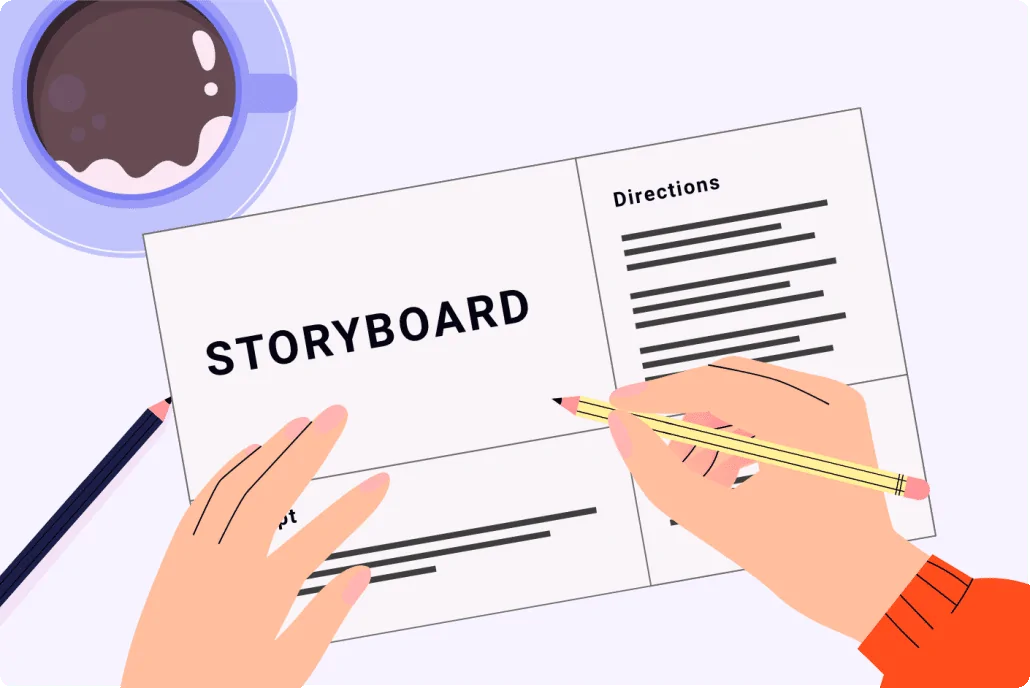
After your script is approved, it’s time to create your storyboard. The storyboard is the blueprint for your animated ad. It tells the illustrators and animators what to create.
Your production team will develop the first draft of the storyboard and send it to you to review. Each page includes a sentence from your script, a rough mockup of the scene, directions for the animators and a list of the assets that are needed to create the scene.
Download Video Igniter’s Free Storyboard Template
When you review the storyboard, focus on the visual ideas that are going to be used to bring your script to life. Do the visuals enhance or detract from the presentation of the key messages in your ad? If you want to make revisions, let the production team know. Otherwise, mark the storyboard as approved so that production can proceed.
4. VoiceOver

Your video animator will help you procure voiceover auditions for your animated ad. Typically, they will order up 1-3 voiceover auditions for each character/narrator in your video. You get a chance to review the auditions and select your favorite(s). Then, the production team will oversee the production of the full voiceover recording to guide the VO artist through the pacing, tone and energy they should use. You get an opportunity to review the full voiceover and request revisions before approving it for production.
5. Soundtrack
The animation studio you are working with will also help select some soundtracks that will enhance the presentation of your animated ad.

Give the soundtracks a listen and let your production team know which one you like best so they can purchase the license to use the music in your ad. Can’t decide which soundtrack you like best? Let them know and they will help you preview your favorite options when the first draft of your animated ad is ready to review.
6. Illustration
Creating illustrations for an animated ad happens in two phases:
- Creation of the concept art
- Creation of the rest of the art

Illustration begins with the creation of concept art. This way, the production team can develop and refine a unique visual style specifically for your animated ad. Once the concept art is fully developed and approved by your team, our animation studio will create all of the rest of the art for your video to match the style of the concept art.
You get an opportunity to review all the illustrations and request revisions before approving the art for animation.
7. Animation

Now that everything is approved, it’s time to animate your ad! 2D animation takes about 1 week for content under 60 seconds in length. When the first draft is ready, give it a detailed review with your team and members of your target audience. Then, collect everyone’s feedback and share it with your animation team so they can incorporate your edits and render out the final draft.
What does it cost to make an animated ad?

Ballpark budget range for a 30-second 2D animated ad: $1,000-$5,000+.
Ballpark budget range for a 30-second 3D animated ad: $3,000-$25,000+.
Check out this article for a more in depth look at animated video pricing.
How do I find an animator to help me make an animated ad?
Picking the right animated video production company to make your animated ad is a key decision in the animated video production process.

Here are some resources to help you find the right animated video production company to produce your animation’s ideal visual style, on time and within your budget:
- 9 Things to Look For When Hiring An Animator to create an animated ad.
- How do you hire an animator?
- How do you outsource an animated video project?
- Pros and Cons of Different Animation Styles
- What goes into production cost of an animated video?
- Learn the different types of online animated video makers.
- Interested in 3D animation? Read about 3D animation makers.
- What’s the difference between hiring an animation studio, a freelance animator and Video Igniter?
- What is Video Igniter Animation?
- Need your video fast? Learn about rush delivery.
How do I promote my business with an animated ad?
Let’s take a look at the tried and true methods you can use to promote your animated ad to your target audience.
1). SEO

The best way to leverage your animated ad is to get your video to appear at the top of Google and YouTube’s search results.
To learn more about Video SEO and how to optimize your videos to appear in search engines, check out our Video SEO guide!
2). Facebook/Instagram
Facebook and Instagram make it easy to create targeted video advertising campaigns to get your animated ad in front of your target audience. Their built in platform tools make it easy to guide viewers to your site or your social pages if they’re interested in learning more about your company and staying connected with your brand while they determine if they want to become a customer of yours.
3). TikTok & SnapChat
TikTok & SnapChat also offer self-service ad platforms like Facebook and Instagram. If you have developed your video to play in vertical mode and you want to reach a B2C audience, consider using TikTok or SnapChat to promote your ad.

4). YouTube Ads
Wanna reach almost any kind of person on the planet with your video message? YouTube is used around the world and offers self-service ad tools that let you promote your animated ad to specific members of your target audience.
5). LinkedIn
If you want to promote a B2B company, Linkedin is the best platform to reach your audience. CPMs and CPCs are higher on Linkedin compared to most platforms but it is one of the few places online that you can reach a business-specific audience with your animated ad at scale.
6). Traditional PR

If your animated ad can be used to explain and illustrate something that is new and topical, consider including it with your PR outreach. It’s a tall order to expect publications to promote your advertisement for free. However, if your video presents a novel idea or makes it possible for people to understand a new complicated idea, it will be easier for the publication to justify including your animated ad when they write an article about your company.
7). Honorable Mention: Hulu
Hulu also has a self-service ad platform that you can use to develop large scale TV advertising programs.
Why use animation to create an ad?
Why do people use animation to create animated promotional ads instead of using live action filmed content for their ad?
Get more awareness

Animated ads help marketers gain awareness better than live action videos. Animated ads use colorful thumbnails and eye candy visuals that make the viewer more likely to click play and give the video a few seconds of attention to see if they want to keep watching.
Makes it easy to understand new information
Animated ads visuals that focus the viewer’s attention and a voiceover to explain your key message(s). You could show a photorealistic 3D animated model of brain neurons firing, or you could break the process down into a simple 2D animated diagram that walks the viewer step by step through what is happening when neurons fire. In either case, the animated visuals make it easier to understand what is happening compared to trying to learn that information from a paper book.

Holds attention, boosts memory recall.
Animated ads introduce new colorful movements every few seconds. This appears to be enough to dramatically increase viewer retention rates throughout the course of the video. As a consequence of paying attention to the ‘user friendly’ visuals that make the information easy to understand, the viewer’s ability to retain information goes up.
Makes it easy to share important messages

There are many ways to promote your message to the world. Sharing a video via a link happens to be one of the most useful and scaleable ways to get a mass media message to large audiences or to a specific target market.
What are some good examples of animated ads?




How long does it take to make an animated ad?

It takes 3-5 weeks to produce most 2D animated video ads. 3D animation takes about twice as long to produce. If you need to speed up production, check out our rush delivery animation option.
To learn more about the animated video production process and how long each stage of the production process takes, check out this companion article:
How long should my animated ad be?
That depends on what your goal is for your animated ad…
If your goal is to get awareness
Aim for a length of 5-60 seconds. Most awareness videos are in the 5-30 second range. The purpose isn’t to tell people your whole story. The goal is to get them intrigued enough to want to learn more and share your story. In many cases, the shorter the better.
If your goal is to educate your leads and prospective clients
For leads and prospects that have already heard about you and want to learn more, your videos should be about 1-2 minutes long.

Long videos are usually reserved for customer education and retention. Longer videos can be used to give an in depth look at your product/service to show how it works. You can also make longer, feature-length content (30-90+ minutes) that would be of interest to your target market. Consequently, this feature-length content could be repurposed to gain awareness among new potential customers as well as delighting your existing clients.
Want to promote your animated ad? Schedule a call with our production team or use this form to get in touch.
How do I maximize the business outcomes of my animated ad?

If you want to maximize the effectiveness of your animated ad, check out the following resources:
- 7 Tips to help you write a great script.
- Pick the right visual style for your promo video.
- 6 Tips To Increase Viewer Engagement.
- Review the Do’s and Don’ts of Explainer Videos.
- 7 Tips For Using and Improving Your Businesses’s Video.
- Learn how to interpret your video’s viewer data to see if it needs improvement.
- A/B Test variations of your promo video to improve its conversion rate.
Emerging Trends in Animated Ads

Animated ads are constantly evolving to match new technologies and consumer preferences. Staying up to date on the latest trends can help your brand stand out and resonate with your audience. Here are some of the most promising trends to consider:
Personalized animated ads
Dynamic personalization, powered by AI, enables brands to tailor animated ads to each viewer’s location, preferences, or recent behavior. Personalized animated ads can dramatically improve engagement rates and conversions by making viewers feel seen and understood.
Interactive animated ads
Interactivity is a major growth area. These ads invite viewers to engage with clickable hotspots, sliders, or quizzes inside the animation itself. Interactive elements increase the time viewers spend with your content and make them more likely to take action afterward.
Hybrid animation and live-action
Brands are experimenting with combining animated elements over live-action footage, creating a fresh and memorable look. This hybrid approach blends realism with the imaginative power of animation, offering the best of both worlds.
AR & VR animated ads
Augmented reality (AR) and virtual reality (VR) are introducing new ways to deliver immersive animated ads. For example, an AR-enabled ad could let someone scan a QR code and see an animated character pop up in their environment, making the ad more playful and shareable.
Social platform–driven styles
Short-form video platforms like TikTok and Instagram Reels are inspiring new visual styles in animated ads — including vertical formats, snappy edits, and stylized transitions. These social-first styles help your ad fit seamlessly into a user’s feed while still delivering a brand message.
By incorporating these trends, you’ll be able to keep your animated ad campaigns fresh, competitive, and highly relevant.
Optimizing Animated Ads for Conversion

Making a beautifully animated ad is only half the job — you also need it to drive results. Here are some best practices to optimize your animated ad for higher conversions:
Clear call to action (CTA)
Your CTA should be visible, memorable, and aligned with your campaign objective. Whether you want viewers to click a link, download an app, or sign up for a newsletter, make the CTA appear on screen clearly, both visually and through narration.
Keep your message focused
Avoid trying to say too much. Animated ads work best when they focus on one or two clear takeaways. Simplify your messaging so viewers instantly understand what you offer and what to do next.
Leverage emotional storytelling
Animation is an amazing storytelling medium. Use it to spark emotions — laughter, hope, curiosity — which will improve retention and make your message stick. Emotionally resonant ads also get shared more.
Test variations
Don’t settle on one version. A/B testing different scripts, visual styles, CTAs, or even voiceover tones can reveal what resonates best with your audience and drive higher conversion rates over time.
Optimize for silent playback
Many people watch ads on social platforms with the sound off. Ensure your animated ad still works visually without a voiceover by adding animated text captions and visual storytelling cues.
Measuring Animated Ad Performance

Once your animated ad is live, you’ll want to measure its performance. Here’s how to track success:
View-through rate (VTR)
This metric tells you what percentage of viewers watched your ad to completion. Higher VTRs suggest your animation is engaging and relevant.
Click-through rate (CTR)
If your ad includes a link, CTR will reveal how well it motivates people to take action.
Engagement rate
On platforms like TikTok or Instagram, this includes likes, comments, shares, and saves. High engagement is a strong signal of a compelling animated ad.
Conversion rate
Ultimately, you want to know how many viewers completed your desired action — for example, purchasing a product or signing up for a service.
Cost per acquisition (CPA)
Tracking CPA can help you understand how efficiently your animated ad is bringing in customers compared to other forms of advertising.
Heatmaps and viewer drop-off
If you’re running the ad on your website or through YouTube, consider heatmaps or retention graphs to see exactly where viewers drop off. That information can guide future improvements.
Advanced Animation Techniques to Consider

If you want your animated ad to stand out even more, you can explore these advanced techniques:
Parallax animation
This gives a subtle 3D depth to 2D scenes, creating a more immersive visual experience.
Frame-by-frame character animation
Rather than relying on software shortcuts, animators can handcraft each frame for more fluid and expressive characters, adding personality and charm.
Kinetic typography
Text can be animated in dynamic ways to become part of the storytelling. Kinetic typography is especially useful when you want to keep messages clear in silent playback environments.
Data-driven animation
For B2B brands, consider animations that visualize complex data in a compelling, understandable way. Animated data visualizations help you turn dry stats into stories that captivate audiences.
Procedural animation
This technique uses algorithms to generate motion dynamically, saving production time while creating mesmerizing patterns, transitions, or effects.
Legal Considerations for Animated Ads

It’s easy to forget that animated ads have legal requirements just like live-action spots. Here’s what to keep in mind:
- Music licensing: Make sure you have commercial rights for your soundtrack.
- Voiceover contracts: Confirm usage rights for the voiceover artist, including any international territories if you plan to distribute globally.
- Intellectual property: Avoid using characters or assets that resemble copyrighted material.
- Disclaimers: If your ad makes health or financial claims, check with your legal advisor to add disclaimers where required.
Accessibility in Animated Ads

Finally, remember accessibility. Making your animated ad inclusive helps you reach a broader audience:
- Provide closed captions for voiceovers.
- Use high-contrast color palettes to assist visually impaired viewers.
- Avoid flashing animations that might trigger seizures.
- Include clear on-screen CTAs instead of only audio-based instructions.
By designing your animated ad with accessibility in mind, you not only follow best practices but also strengthen your brand’s reputation for inclusivity.
Types of Animated Ads for Different Marketing Goals

Not every animated ad should be designed the same way. The best format depends on what you want the viewer to do after watching the advertisement. A brand awareness campaign, product launch, retargeting campaign, and direct-response advertisement can all use animation, but each requires a different creative approach.
Product Demonstration Ads
A product demonstration animated ad shows potential customers how a product works. This is particularly useful for software, technology, consumer products, medical devices, and products with features that are difficult to demonstrate with traditional photography.
For example, a software company could use animation to show a customer uploading a document, processing it through the platform, and receiving a finished result. Instead of simply telling viewers what the product does, the animation visually demonstrates the customer experience.
Product demonstration ads work particularly well when the product has an unfamiliar interface, complicated functionality, or an invisible process that would be difficult to film.
Problem-Solution Animated Ads
A problem-solution advertisement begins by identifying a problem experienced by the target audience and then introduces the advertised product or service as the solution.
This structure is especially effective for B2B companies and service businesses because it immediately establishes relevance. Instead of beginning with a company introduction, the advertisement begins with something the prospective customer already recognizes.
A simple structure might look like this:
Problem → Consequences → Solution → Benefits → Call to action
For example, an accounting software company might begin with a business owner struggling with spreadsheets, duplicate data entry, and missed deadlines. The animation can then introduce the software and visually demonstrate how it eliminates those problems.
Product Launch Animated Ads
Animation can also be an effective way to introduce a new product, feature, service, or company.
A product launch ad doesn’t necessarily need to explain every feature. Its primary purpose may be to generate curiosity and encourage viewers to visit a landing page, sign up for a demonstration, download an app, or learn more.
For a product launch, consider creating several versions of the animated ad rather than relying on one long video. A short teaser can generate awareness, while a longer advertisement can explain the product after viewers have expressed interest.
Testimonial-Style Animated Ads
Customer testimonials don’t always need to be filmed interviews. An animated advertisement can transform customer experiences, quotes, statistics, and success stories into visual narratives.
For example, an animation could introduce a fictionalized customer journey, show the problems the customer encountered, explain how the product helped, and finish with measurable results.
This approach can be particularly useful when customers are unwilling or unable to participate in filmed testimonials.
Educational Animated Ads
Some products require education before a customer can appreciate their value. An educational animated ad can introduce a complicated concept and then connect that concept to the company’s product or service.
This format is useful for industries such as healthcare, finance, technology, cybersecurity, insurance, education, and professional services.
The important distinction is that an educational ad should still function as an advertisement. Don’t overwhelm viewers with information simply because animation makes it possible to explain complex subjects. Choose the information that helps the viewer understand why the product or service matters.
How to Structure an Animated Ad

One of the most important decisions in animated ad production happens before any animation is created: determining what information belongs in the video.
A strong animated advertisement generally has a simple narrative structure. The exact structure can vary depending on the campaign, but the following framework provides a useful starting point.
1. Start With the Audience
The opening seconds should immediately establish relevance.
Rather than starting with a long company introduction, consider opening with a question, problem, surprising statement, visual situation, or recognizable customer experience.
The viewer should quickly understand that the advertisement is relevant to them.
2. Introduce the Problem or Opportunity
Once you’ve captured attention, explain the situation that your product or service addresses.
This section should be concise. The goal isn’t to describe every possible problem your customers encounter. Focus on the most important problem connected to the campaign.
3. Present the Solution
Introduce the product or service as the solution.
Animation provides an advantage here because virtually anything can be visualized. You can animate a product interface, create a diagram, visualize an invisible process, demonstrate a physical product, or represent an abstract concept.
4. Explain the Most Important Benefits
Focus on outcomes rather than simply listing features.
For example, instead of saying that software includes “automated reporting,” explain that automated reporting allows the customer to spend less time manually compiling reports.
The animation should reinforce these benefits visually.
5. End With One Clear Action
The final section should tell viewers what to do next.
Examples include:
- Visit the website
- Start a free trial
- Request a demo
- Download an app
- Get a quote
- Learn more
- Sign up
- Contact the company
Avoid giving viewers several competing instructions. One primary CTA usually makes the advertisement easier to understand.
Designing Animated Ads for Different Screen Sizes

An animated advertisement should be designed for the environment in which it will be viewed.
A video created for a television commercial doesn’t necessarily work well as a social media advertisement. Similarly, an animation designed for YouTube may need significant changes before it works effectively as a vertical mobile advertisement.
Horizontal Animated Ads
A 16:9 horizontal format remains useful for YouTube, websites, presentations, connected TV, and many traditional video advertising placements.
Horizontal videos provide substantial space for characters, environments, product interfaces, diagrams, and multiple visual elements.
Vertical Animated Ads
Vertical video is particularly useful for mobile-first platforms. A 9:16 composition allows the animation to occupy most of the viewer’s smartphone screen.
When creating vertical animated ads, don’t simply crop a horizontal video after production. Important characters, text, products, and other visual elements may end up outside the safe viewing area.
It is better to design the composition specifically for the vertical format.
Square Animated Ads
Square video can also be useful for social feeds and other environments where a traditional horizontal video doesn’t occupy enough screen space.
If you expect an animated ad to run across multiple platforms, discuss the required aspect ratios with your animation production company before production begins. Planning for multiple formats from the beginning can reduce the amount of work required later.
How to Create Animated Ads for a Full Marketing Funnel

An animated advertisement doesn’t have to perform every job in your marketing funnel.
In fact, creating several advertisements for different stages of the customer journey can be more effective than attempting to create one video that appeals to everyone.
Top-of-Funnel Animated Ads
At the awareness stage, viewers may know nothing about your company. The advertisement should therefore focus on generating attention and establishing a simple connection with the audience.
Short animations, humorous concepts, surprising visuals, memorable characters, and strong visual hooks can work well at this stage.
Middle-of-Funnel Animated Ads
People in the consideration stage need more information.
A longer animated ad can explain how the product works, demonstrate important features, compare different approaches, or address common objections.
At this stage, the viewer already has some interest, so the advertisement can provide more detail.
Bottom-of-Funnel Animated Ads
People close to making a purchase typically need reassurance rather than a broad introduction.
An animated advertisement at this stage could emphasize pricing, specific benefits, customer results, product differentiators, implementation, guarantees, or a particular offer.
The CTA should also be more direct.
Repurposing One Animated Ad Into Multiple Marketing Assets

A major advantage of investing in an animated advertisement is that the finished production can often become the source material for additional marketing content.
Instead of producing one video and using it only once, consider creating multiple versions during the production process.
A 60-second animated advertisement could potentially be adapted into:
- A 15-second social media advertisement
- A 30-second paid advertising version
- A vertical mobile version
- Short clips for social media
- A website hero video
- A sales presentation asset
- A product demonstration
- An email marketing asset
- A YouTube advertisement
- Short animated GIFs
- Individual animated scenes for social posts
This approach can make the original production investment more valuable because the same creative assets can support multiple marketing campaigns.
When planning the project, tell your animation team how you intend to distribute the content. They can design characters, illustrations, compositions, and scenes with future adaptations in mind.
Common Animated Ad Mistakes to Avoid

Even a technically impressive animation can fail if the creative strategy isn’t right. Avoid these common mistakes when developing an animated ad.
Trying to Explain Everything
One of the most common mistakes is attempting to fit an entire website’s worth of information into a short advertisement.
An animated ad isn’t supposed to answer every possible question. Its job is to communicate the most important message and encourage the viewer to take the next step.
Prioritizing Animation Over the Message
Visual effects should support the advertisement’s message rather than distract from it.
Complex transitions, elaborate camera movements, and impressive effects aren’t valuable if the audience doesn’t understand what they’re supposed to remember.
Making the Introduction Too Slow
The beginning of the video is critical. Spending the first several seconds on logos, company history, or generic introductions can give viewers a reason to leave before they hear the actual message.
Get to the point quickly.
Using Too Much On-Screen Text
Animation can communicate information visually, but excessive text can make the advertisement difficult to follow.
Use on-screen text strategically to reinforce important information, especially when the video may be viewed without sound.
Forgetting the Landing Page
The advertisement and the destination page should work together.
If an animated ad promises a specific offer, product feature, or benefit, the landing page should immediately reinforce that same message. A mismatch between the advertisement and landing page can create unnecessary friction after the viewer clicks.
Creating Only One Version
Marketing campaigns benefit from experimentation.
Instead of assuming you know which opening, CTA, visual style, or message will perform best, consider creating multiple variations that can be tested against one another.
How to Choose an Animation Style for an Advertisement

The visual style of an animated ad should be chosen based on the audience, brand, message, and distribution channel rather than personal preference alone.
Common approaches include:
2D character animation: Useful for storytelling, humor, emotional messaging, and human-centered advertisements.
Motion graphics: Effective for technology companies, B2B advertisements, statistics, product features, and typography-driven concepts.
3D animation: Useful when the advertisement needs to showcase physical products, realistic environments, product features, simulations, or premium visual presentation.
Kinetic typography: Useful when the message depends heavily on memorable statements, statistics, or short phrases.
Illustrated animation: Useful for brands looking for a distinctive visual identity that doesn’t rely on photorealism.
Hybrid animation: Combines live-action footage with animated characters, graphics, effects, or typography.
The right style is the one that makes the advertisement’s message easier to understand while reinforcing the brand.
Animated Ads vs. Live-Action Ads

Animation isn’t automatically better than live-action video. Each production method has different advantages.
Live-action can be particularly effective when the advertisement depends on real people, physical locations, product demonstrations, or authentic customer interactions.
Animation becomes especially valuable when the concept requires something that is difficult, expensive, dangerous, impossible, or impractical to film.
For example, an animated advertisement can visualize microscopic processes, futuristic technology, software systems, internal bodily processes, imaginary environments, abstract ideas, or highly stylized worlds.
Animation also provides greater control over the visual presentation. Once the artwork is created, elements can be changed, moved, recolored, or reused without needing to reshoot an entire scene.
The decision should therefore come down to the message you need to communicate rather than choosing animation simply because it looks interesting.
Creating an Animated Ad Campaign Instead of a Single Video

For companies running ongoing advertising campaigns, it can make sense to think beyond a single animated ad.
An animated campaign can use a consistent visual identity across multiple advertisements while changing the message for different audiences, products, offers, or stages of the customer journey.
For example, a company could create:
- A short brand awareness advertisement
- A product-focused advertisement
- A customer problem-solution advertisement
- A feature demonstration
- A customer success story
- A retargeting advertisement
- A promotional advertisement
Using consistent characters, colors, illustration styles, animation techniques, and branding can make the individual advertisements feel like part of the same campaign.
This approach can also make future production more efficient because some visual assets can potentially be reused or adapted rather than recreated from scratch.
Animated Ad Production Checklist

Before sending an animated advertisement into production, make sure you can answer the following questions:
- Who is the advertisement targeting?
- What problem does the audience have?
- What is the single most important message?
- What action should viewers take?
- Where will the advertisement be shown?
- What aspect ratios are required?
- Will viewers potentially watch without sound?
- What brand guidelines need to be followed?
- Are there legal disclaimers or required disclosures?
- What visual style fits the campaign?
- What length is appropriate for the placement?
- Which metrics will determine success?
- Will multiple versions be tested?
- Can the finished animation be repurposed into additional marketing content?
Answering these questions before production begins can prevent expensive changes later.
The more clearly the creative team understands the advertisement’s objective, audience, distribution strategy, and success criteria, the easier it becomes to make production decisions that support the campaign.
How do I save money on my animated advertisement production budget?
- You can write the script for your animated ad.
- You can create the storyboard for your animated ad.
- You can use free (legal) music.
- You can record the voiceover for your animated video ad.
- Consider using stock assets.
For more tips on affordable animation and how to keep your production budget as low as possible, check out this companion article:
Final Thoughts on Creating an Animated Ad
An effective animated ad is more than a collection of attractive visuals. It combines strategy, writing, design, animation, sound, distribution, and measurement into a single marketing asset.
The most successful projects begin with a clear understanding of the audience and the action the advertiser wants that audience to take. From there, the script, visual style, animation techniques, aspect ratio, soundtrack, and CTA can all be selected to support that objective.
Animation gives businesses an enormous amount of creative flexibility. It can turn complicated products into simple visual explanations, transform abstract ideas into stories, demonstrate products that are difficult to film, and give brands a distinctive visual identity.
If you’re planning an animated ad, think about the entire campaign rather than only the video itself. Consider where the advertisement will appear, how viewers will encounter it, what they should do afterward, which variations you may want to test, and how the finished animation can be repurposed.
With that strategy in place, your animated advertisement can become more than a promotional video—it can become a reusable marketing asset that supports awareness, education, lead generation, and conversions across multiple channels.
Still have questions about animated ads?
Do you have a question about making or using an animated ad that wasn’t answered in this FAQ? Use this form to contact us with your question. We will follow up with an answer and then we’ll post the question and answer to this page.

What is Video Igniter Animation?
Video Igniter Animation is an online animated video production service. By working with our team online, you can get your custom animated video produced faster and for less than hiring a brick and mortar animation studio.
We can help you create any kind of 2D animation or 3D video you can imagine. Check out our animated video portfolio!
Watch our explainer video to learn more about how we can help you create an animated ad for your business:

Looking For An Animated Ad Production Company In The U.S.A.?
Video Igniter is headquartered in Seattle, Washington.
Animated Ad Success Stories & Testimonials
“Video Igniter offered us the critical combination of creative value, clear communication, and patience with stakeholder feedback. We ended up with truly high-quality design assets for our video series largely due to the extra level of commitment — and the right balance of efficiencies with flexibility in the process when called for.”
Larry Schlessinger – Sr. Creative Program Manager, Amazon Web Services
“I am beyond satisfied with my experience with Video Igniter. The first drafts of the work were almost exactly what I had in my head when developing the concept. After that each step along the way was seamless until arriving at a perfect finished product. And all this at a tremendous value. Anyone who has considered creating a marketing video should check out Video Igniter.”
Anonymous Customer Feedback
“Video Igniter came to us with a number of creative and engaging ideas and were able to create an exciting, impactful video in a short period of time. And the best part was that it cost much less than other options of similar quality. The video they made is a great marketing tool for us.”
Alex Raymond – Founder, Kapta Systems

Get in touch about creating your animated ad
Schedule a call to discuss your animated ad project with our production team.
Get a quote for us to create your animated advertisement.
Request access to our newest price sheet.
Create your Video Igniter account, fill out a creative brief, and we’ll start creating your animated ad.