Learn About Different Styles Of Animation

With so many different animation styles out there, we thought it would be helpful to present an overview of the most common types of animated videos and provide a run down of their pros and cons to help you figure out which animation styles could be used for your video.

2D Animation Styles:

1). Flash / After Effects 2D animation
2). Motion Graphics
3). Hand Drawn Animation (aka Frame by Frame or Cel Animation)
4). Kinetic Typography
5). Cut-Out Animation
6). Rotoscoping Animation

3D Animation Styles:

1). 3D Animation
2). Stop Motion
3). Cel-Shaded Animation

Non-Animated Explainer Videos:

1). Screen Recording
2). Whiteboard Videos

2D Animation Styles:

1). Flash / After Effects 2D Animation

If you’ve seen a 2D animated video online, odds are, it was likely made using Adobe Flash or Adobe After Effects. These are two of the most popular programs for creating 2D animated videos because they enable an infinite range of different animation styles at a lower cost than producing a video with traditional frame-by-frame (hand drawn) animation.

Pros: Enables you to create infinite different types of animation styles. Very easy to make custom branded art.

Cons: This is what everyone does. Can be difficult to pick out which studio or freelancer is best for you.

Example of an Animated Explainer Video Created with Flash:

Example of a More Advanced Animation Created with Adobe After Effects:


2). Motion Graphics

Think of motion graphics as a type of animation that’s more like an animated diagram or a series of shapes, icons and text sliding around. Generally this is animation that doesn’t have people walking around. Instead, motion graphics are used like visual accents. Sometimes they are overlaid on top of live action videos, other times they’re inserted between scenes of a video to show an animated diagram that visually illustrates what a narrator is explaining.

Pros: Can be simpler to produce than traditional animation.

Cons: May not include enough detail for what you want to show or explain.


3). Hand Drawn Animation aka Frame-By-Frame Animation

This is the ‘real’ old school style of animation. The kind where each frame of the animation is hand drawn by the video animator. It enables the artist to create beautiful flowing animated details with realistic, smooth movements. It also takes a lot of time, skill and a huge team with an adequate budget to produce anything more than a few seconds long.

Pros: Visually unique compared to the glut of 2D animated content out there.

Cons: Expensive. Takes a long time and a big team to produce.

YouTube video

4). Kinetic Typography

Kinetic typography is a type of animated video that relies heavily on animating text with flashy motion and designs to keep the viewer engaged. Sometimes characters and scenes get mixed in but typically the goal is to animate the words in visually unique ways in sync with the narrative voiceover.

Pros: When designed with proper timing, these videos do a great job at keeping viewer’s interest. It’s also possible to watch these videos without the sound on (i.e. in a social media feed) and still be able to understand the content of the video w/out the audio.

Cons: Since the focus tends to be text-based, sometimes content that’s presented in kinetic typography videos should actually be an animated diagram (which you can totally mix into your video).

YouTube video

5). Cut-Out Animation

Cut-out animation uses flat materials, like paper or fabric, to create characters and scenes that move in a two-dimensional space. Traditionally, this style involved physically moving cut-out pieces frame by frame, but modern software now simulates the process digitally. Cut-out animation is popular for its cost-effectiveness and charming simplicity, as seen in shows like South Park. If you’re looking for a fun, quirky, and budget-friendly animation style, cut-out animation might be a perfect fit.

Pros: This fun animation style is visually unique and helps your message stand out from other forms of 2D computer animation.

Cons: Creating this style of animation takes more time to create compared to modern forms of computer animation.

YouTube video

6). Rotoscoping

Rotoscoping involves tracing over live-action video footage to create lifelike movement in an animated format. This style blends realism with artistic expression, making it a great option when you want natural character motion with a stylized visual appeal. Rotoscoping was famously used in films like A Scanner Darkly and Waking Life to create a surreal, dreamlike effect that draws viewers into the story.

Pros: Visuals include realistic, natural movement using a unique stylized aesthetic.

Cons: Rotoscoping is a time-consuming, expensive process which requires a film crew to capture video content before animators can trace over each scene.

YouTube video

Types of 3D Animation:

1). Animated Computer Generated 3D Visuals

3D animation is ideal for when you want to take a viewer on a journey inside a 3D space to show what an environment is like or to understand the inner workings of a machine. 3D animation also works great for your standard business explainer video if you want to go for a high impact visual style that stands out from the rest. Just note that 3D animations take longer to produce, require a larger budget, and it’s not as easy to make changes to the video once production has begun. 3D animated video styles can look cartoon-ish (like Pixar movies) or they can be made to look like photo-realistic renderings of the real world.

Pros: Great for showing how products/machines work or exploring 3D environments

Cons: Expensive and takes a long time to produce. Difficult to make changes mid-way through video production.

Cartoon-style 3D:

YouTube video

Photo-realistic 3D:


2). Stop motion

Stop motion animation is created by setting up a scene (could be made of clay, paper, legos, etc), taking a photo, moving a few things slightly in the scene, and taking another picture. By repeating this process of taking photos of the scene with slight adjustments, the images can be combined to create a moving animated scene.

Pros: Fun and unique to watch.

Cons: Expensive and it takes a long time to do a good job – definitely can’t be rushed.

YouTube video

3). Cel-Shaded Animation

Cel-shaded animation gives 3D objects a flat, cartoonish appearance reminiscent of traditional 2D animation. It’s often used in video games and stylized animations to create bold, eye-catching visuals. Titles like The Legend of Zelda: The Wind Waker and Arcane demonstrate how cel shading can blend modern 3D animation with classic, hand-drawn aesthetics.

Pros: Evokes a nostalgic, hand-drawn aesthetic with modern computer animation tools. Rendering costs are lower compared to photorealistic 3D animation.

Cons: Limited realism compared to traditional 3D animation. Requires talented artists to do a quality job creating this visual style.

YouTube video

Non-animated explainer videos:

1). Screen recording

Sometimes you want to show what’s actually happening on a phone, tablet or computer screen. In this case, you can use different programs to record what is happening on screen to show exactly what is happening, rather than providing a high level story of what an app actually does. Motion graphics are sometimes mixed in to keep the viewer’s attention and to visually call out specific details on screen.

Pros: Great for showcasing how to use different websites, software and apps.

Cons: Generally kinda boring to watch unless there’s some unique motion graphics overlaid on top of the screen recording. Not great for sales/marketing videos, but that’s not what they’re really meant for anyway.


Deep Dive: How to hire and collaborate with a motion graphics company?

2). Whiteboard videos

Whiteboard videos are another style of hand drawn animation – however, unlike Frame-by-Frame animation, where the animator draws each frame individually and then flips through them to make the image look like it’s in motion, whiteboard explainers are videos that show the artist in the act of drawing out visuals in sync with a voiceover.

Pros: Generally quick and less expensive to produce. Great at keeping the viewer’s attention.

Cons: They all look very similar so they’re not great for brand recognition.

YouTube video

Practical Applications for Different Animation Styles

The type of content you want to create often informs the visual style that’s appropriate for the video. Below, you can see our recommendations for which style(s) of animation are appropriate to use for creating educational, entertaining and promotional video content.

Educational Content

different animation styles educational content

Animations simplify abstract concepts and make learning more accessible. Animated educational videos often use 2D animation and motion graphics to illustrate scientific principles, historical events, and mathematical theories.

Entertainment

From children’s cartoons to adult animated series, the entertainment industry uses a diverse range of styles to appeal to different audiences. 2D, 3D, and stop motion animation have all found success in TV, movies, and online content.

Marketing and Advertising

marketing content

Animation helps brands stand out in competitive markets by delivering memorable, engaging content. Motion graphics and character animations are popular choices for commercials, product explainers, and social media content.

Choosing the Right Animation Style

different animation styles 2d or 3d

The right animation style depends on your video’s goals, target audience, and budget. If you need something cost-effective and fun, 2D animation might be the way to go. For high-impact, immersive content, 3D or mixed media animation could be a better fit.

With so many cool animation styles to choose from, it can be difficult to narrow it down to the right option for your video. If you’re still not sure which types of animation are appropriate for your video, send us a message or schedule a call to discuss your video project and goals with Video Igniter’s production team.

Key Factors That Influence Different Animation Styles

Key Factors That Influence Different Animation Styles

When evaluating different animation styles, it’s important to understand the practical factors that influence which approach makes the most sense for your project. While aesthetics matter, production constraints often play an equally important role in determining the final style.

One major factor is budget. Some animation styles, like frame-by-frame hand-drawn animation or photorealistic 3D animation, require significantly more time and specialized talent. This increases cost. More streamlined animation styles, such as motion graphics, cut-out animation, or kinetic typography, are typically more affordable while still delivering strong visual impact.

Timeline is another critical consideration. If you’re working with a tight deadline, simpler animation styles are often the best choice. Motion graphics, screen recordings, and limited 2D animation can be produced relatively quickly compared to stop motion or complex 3D animation, which often require longer production schedules.

Your distribution platform also matters. Animation styles that work well on a website homepage may not perform the same way on social media or in paid ads. Bold, simplified visuals with strong contrast—such as motion graphics and kinetic typography—often perform better on mobile feeds where viewers scroll quickly.

Comparing 2D vs 3D Animation Styles

Comparing 2D vs 3D Animation Styles

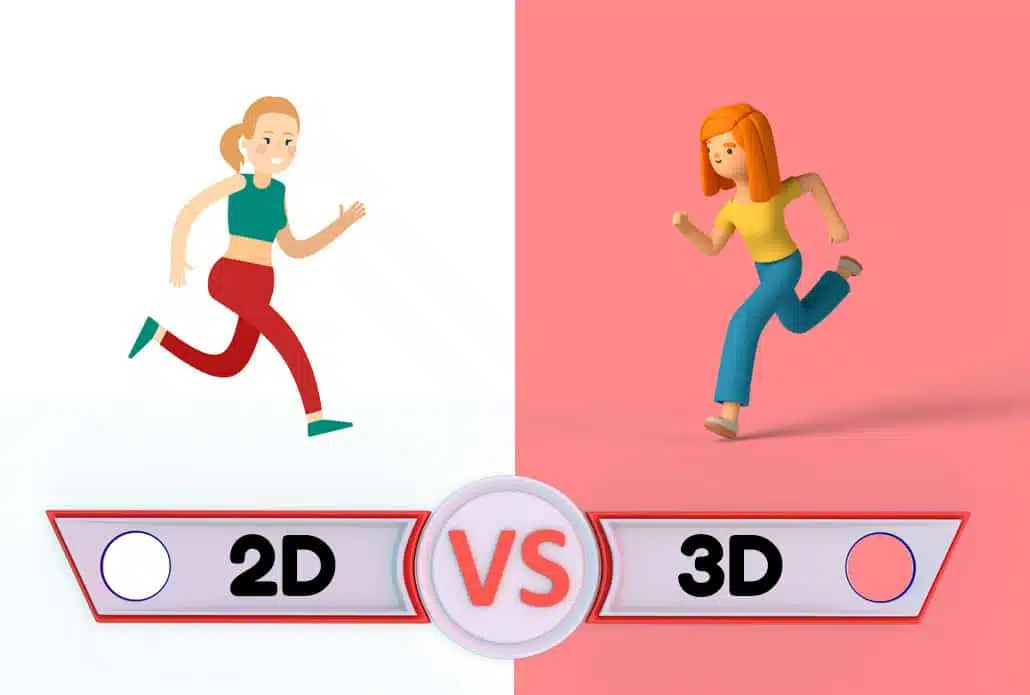
One of the most common decisions people face when exploring different animation styles is whether to choose 2D or 3D animation. Each has distinct advantages depending on your goals.

2D animation styles are often favored for explainer videos, brand storytelling, and educational content. They are cost-effective, flexible, and easier to revise mid-production. 2D animation also lends itself well to custom brand design, allowing companies to maintain consistent visual identity across marketing materials.

3D animation styles, on the other hand, are ideal for showcasing physical products, architectural spaces, or complex machinery. They allow viewers to see objects from every angle and understand how components interact in three-dimensional space. While more expensive, 3D animation can create a premium, high-impact look that stands out in competitive industries.

In many cases, a hybrid approach works best. Combining 2D animation with 3D elements or motion graphics allows brands to balance visual impact with budget efficiency.

How Animation Style Impacts Viewer Engagement

How Animation Style Impacts Viewer Engagement

Different animation styles influence how audiences perceive and engage with video content. Fast-paced motion graphics and kinetic typography are effective at grabbing attention quickly, making them well suited for short-form content and ads. These styles rely on rhythm, timing, and visual momentum to keep viewers engaged.

Character-driven animation styles, such as 2D character animation or rotoscoping, tend to create stronger emotional connections. When viewers see characters reacting, struggling, or succeeding, they’re more likely to remember the message being communicated.

Highly detailed animation styles like hand-drawn animation or stop motion often feel more “crafted” and artistic. This can elevate brand perception, especially for creative industries, entertainment brands, or companies that want to emphasize originality and craftsmanship.

Understanding how different animation styles affect engagement helps ensure your video doesn’t just look good—it performs well.

Animation Styles for Branding and Visual Identity

Animation Styles for Branding and Visual Identity

Animation plays a significant role in shaping a brand’s visual identity. The animation style you choose should align with your brand’s personality, tone, and long-term marketing strategy.

Minimalist motion graphics and clean typography often suit modern tech companies, SaaS platforms, and startups that want a sleek, professional look. Hand-drawn or cut-out animation styles work well for brands that want to feel approachable, playful, or human.

Consistency is key. Once you select an animation style, it’s beneficial to reuse visual elements, character designs, and motion patterns across multiple videos. This builds brand recognition and makes future video production more efficient.

Emerging Trends in Different Animation Styles

Emerging Trends in Different Animation Styles

As technology evolves, so do animation styles. One growing trend is the use of AI-assisted animation, where tools help generate visuals, automate motion, or speed up production workflows. While human creativity remains essential, AI tools are enabling faster iteration and lower costs for certain animation styles.

Another trend is mixed media animation, which blends live action footage with animated overlays, motion graphics, and text. This approach combines the authenticity of real footage with the clarity and flexibility of animation.

Social media has also influenced animation trends. Short, looping animations with bold visuals and clear messaging are becoming increasingly popular for platforms like Instagram, TikTok, and LinkedIn.

Using Different Animation Styles Across the Marketing Funnel

Using Different Animation Styles Across the Marketing Funnel

Different animation styles serve different purposes depending on where viewers are in the marketing funnel. At the awareness stage, visually striking styles like motion graphics, kinetic typography, or stylized 2D animation help capture attention.

During the consideration stage, explainer-focused animation styles—such as character animation or product walkthroughs—help educate viewers and build trust. For conversion-focused content, screen recordings or product-focused 3D animation can clearly demonstrate functionality and value.

By aligning animation style with viewer intent, brands can maximize the effectiveness of their video content.

Final Thoughts on Different Animation Styles

There is no single “best” animation style—only the best style for your specific goals. By understanding the strengths, limitations, and use cases of different animation styles, you can make informed decisions that balance creativity, budget, and performance.

Whether you’re creating an explainer video, marketing campaign, educational series, or branded content, choosing the right animation style is one of the most important steps in producing a successful video.

What is Video Igniter Animation?

Video Igniter Animation is an online animated video production service. By working with our team online, you can get your custom animated video produced faster and for less than hiring a brick and mortar animation studio.

Watch the demo reel below for examples of the kinds of animation our team can produce for you.


Looking For An Animated Video Company In The U.S.?

Video Igniter is headquartered in Seattle, Washington.

Success Stories & Testimonials

Don’t just take our word for it – these testimonials highlight Video Igniter’s reliability, creativity, flexibility and ability to deliver animations that exceed expectations. When you choose Video Igniter Animation, you can rest assured that you are working with a trusted and reputable studio.

“Couldn’t be happier with Derek and his team. The quality of the work for the cost far exceeded expectations and surpasses anything in the market. Derek was patient, offered many revisions, and was overall great to work with.”

Alex Novick – Founder, Sproutly.com

“Video Igniter were very easy to work with and the entire process for creating and suggesting edits was seamless and stress-free. I would work with them again and would recommend to others looking to create a modern and stylish explainer video.”

Clair Simpson – VP Marketing, Repool.com

“I run a video production company and outsource animation. The team at Video Igniter did a great job in taking the concept I very crudely drew out and making it into a beautiful animation. The review process was easy and their turnaround time was very quick. I’d def recommend them if you’re looking for an animation project.”

Pat Henderson – Founder, Path8 Productions

“Video Igniter offered us the critical combination of creative value, clear communication, and patience with stakeholder feedback. We ended up with truly high-quality design assets for our video series largely due to the extra level of commitment — and the right balance of efficiencies with flexibility in the process when called for.”

Larry Schlessinger – Sr. Creative Program Manager, Amazon Web Services

“Video Igniter came to us with a number of creative and engaging ideas and were able to create an exciting, impactful video in a short period of time. And the best part was that it cost much less than other options of similar quality. The video they made is a great marketing tool for us.”

Alex Raymond – Founder, Kapta Systems

different animation styles testimonials

Get in touch!

Schedule a call to discuss your animated video project.

Get a quote for us to create your animated video.

Request access to our newest price sheet.

Create your Video Igniter account, fill out a creative brief for your video and we’ll begin production as soon as we receive your production deposit.

contact us

Building a Great Storyboard For An Explainer Video

Building a great storyboard for an explainer video will set your video project up for success. Whether you’re creating the storyboard yourself or hiring an animation studio/freelancer to create it for you, this article will teach you how to ensure you end up with a polished storyboard that will be easy for your illustrators and animators to understand what you want them to create.

What is a storyboard?

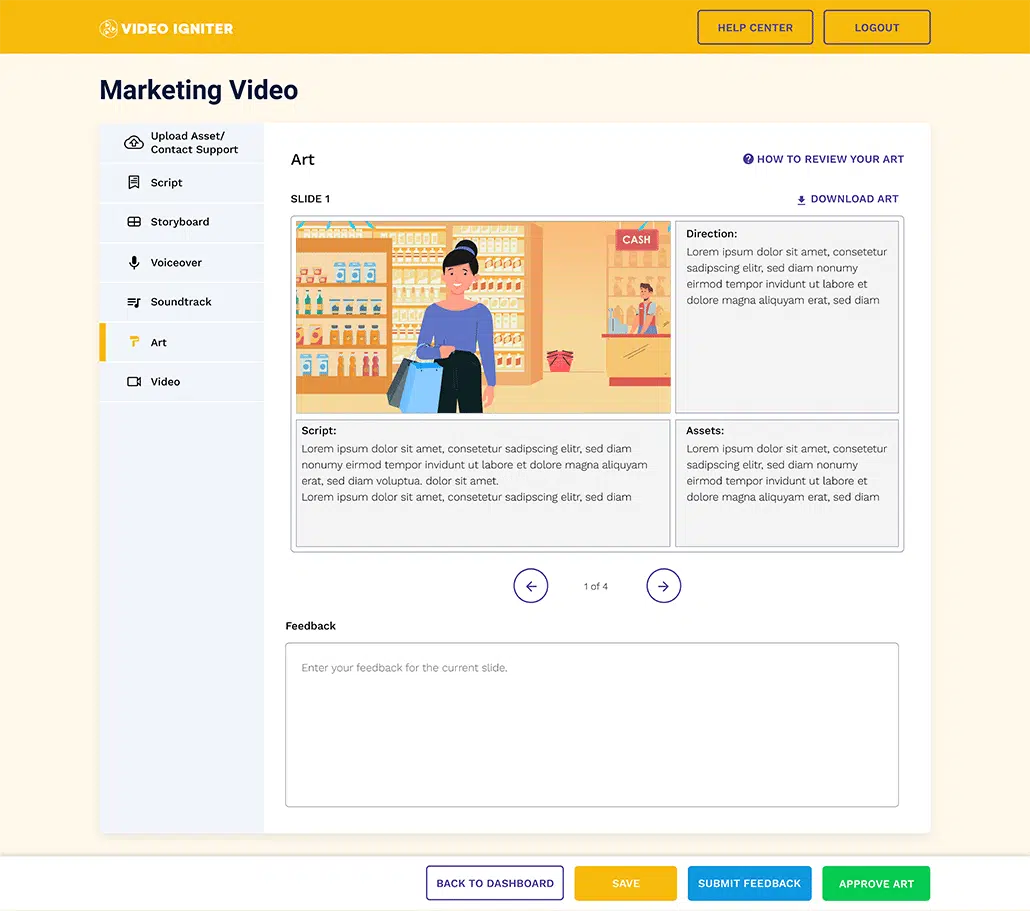
A storyboard is like a blueprint for your animated explainer video. It’s a document made by the creative team that needs to be approved by the client before moving forward with production. The storyboard specifies what visuals need to be created for each sentence of the script and how the images are going to move in sync with the narration.

animation storyboard

Download Video Igniter’s Free Storyboard Template


Why make a storyboard for your animated explainer video?


Helps lower your production budget

Creating your own storyboard can help you save hundreds or thousands of dollars off the price of your explainer video. You can create a storyboard even if you don’t think you have any artistic abilities. Stick figure sketches are good enough to help our illustrators know what you want them to create.

cost saving tips

Helps production run smooth

The storyboard helps everyone involved with your explainer video get consensus about what is going to be created. It’s the blueprint that tells the illustrators what they need to illustrate for each scene. It also provides instructions for the animators so they know how to make the illustrations move in sync with the voiceover.

Without clear documentation, the illustrators might waste time creating the wrong art and the animators wouldn’t know exactly what they’re supposed to animate.

It’s important to take the time to clearly and unambiguously document everything you want the animation team to create. Every detail left unspecified means you are ok with the creative team coming up with their own way to show something. If a character’s hair needs to be a specific color, say so in the storyboard. If a certain movement shouldn’t happen in a scene until a key word is spoken by the narrator, include that detail in your storyboard’s instructions. The more specific you are, the smoother production will go.

How to create a storyboard for an explainer video?


1). Download our free explainer video storyboard template

Our free explainer video storyboard template is a great way to keep your production budget low. You can create a storyboard even if you don’t think you have artistic abilities.

2). Use Powerpoint, Keynote or Slides to create your storyboard

Building a great storyboard for an explainer video using Powerpoint Keynote or Slides

Count how many sentences are in the script for your explainer video. Then, open up our storyboard template in Google Slides, Microsoft PowerPoint or Apple Keynote. You will see one page of the storyboard template in the document. Duplicate that page so that you have as many pages in your storyboard as you have sentences in your script.

3). Add your script

Copy the first sentence of your explainer video’s script. Paste it in the box in the lower left corner of the storyboard. Repeat for every sentence of your storyboard.

How to build a storyboard for an explainer video put one sentence on each slide

Put one sentence on each slide of your explainer video’s storyboard.

If a sentence is particularly long or there is a lot of action happening during it, consider breaking that sentence up into multiple slides. This will allow more space for you to provide instructions to the illustrators and animators.

How to build a storyboard for an explainer video split long sentences into multiple slides


4). Mock up the visuals

Next, you’ll mock up the visuals for each scene in the upper left corner of the storyboard. All you need is a rough napkin sketch of what you want to show in the scene. Something that provides a rough layout of what you want to show in the scene. Take a photo of your sketch and paste it into the storyboard. Repeat for each slide.

How to build a storyboard for an explainer video add visuals to the storyboard

Add visuals to your explainer video’s storyboard so the design team knows what to create.

Alternately, if you don’t want to sketch out each scene, you could mock up each scene using free clip art and stock assets you find online.

Use free clip art and stock assets to mock up the visuals for your explainer video's storyboard.

Use free clip art and stock assets to mock up the visuals for your explainer video’s storyboard.

Don’t worry about making your scene mockups or sketches look perfect. It’s our job to turn your storyboard into the finalized art for the explainer video.

Watch your storyboard get turned into an animated explainer video


5). Describe the motions

After the visuals are established, you’ll want to explain how you expect the elements in the scene to move. Use the box in the upper right corner to provide a bullet point list of simple instructions that tell the animators what you want to see happen in sequential order. If two things happen simultaneously, say so. If something is supposed to happen in sync when the voiceover says a certain word, say so. When in doubt, over explain what you want to happen. The more information the better.

Add instructions for your explainer video's storyboard

Add instructions for your explainer video’s storyboard


6). Create the asset list

The final piece of information that needs to be included in your storyboard is a list of the assets that need to be created for each slide. This can include background and scene design, characters and the clothes they wear, objects, special effects, icons, logos, sound effects and more. Be specific. The storyboard sketch isn’t detailed so use this place to provide information about how you want things to look. What does the character look like? What color surfboard are they holding? How intense should the waves sound in the background, etc.

Describe what assets are needed for each scene of your explainer video

Describe what assets are needed for each scene of your explainer video


7). Review with your team + target audience

When the first draft of your explainer video’s storyboard is complete, share it with your in-house creative team. Make sure it accurately reflects the messages you want to broadcast to the world. It’s also wise to run the storyboard by members of your target audience to ensure it makes sense with them. If any last minute changes need to be made, it’s much better and less expensive to address them during the storyboard phase rather than waiting til the art and animation have been produced.

Review the first draft of your explainer video with your team.

8). Export the storyboard as a PDF for production

After your storyboard is approved for production, export it as a PDF so you can easily share it with the illustrators and animators working on your animated video.

Export your document as a PDF.

Now you’re ready to choose a video animator to help turn your storyboard into a custom animated explainer video. Not sure what kind of animation service provider is right for your project? Check out our pros and cons list to help you decide what kind of animator is right for your project.


Tips to help you build a great storyboard for an explainer video


Use clip art to mock up your visuals

Storyboards for big budget animations are created with detailed sketches for each part of the script.

Example Of A Hand Drawn Storyboard

Most short animated videos that are created these days don’t require something this detailed. In most cases, you can create a simple stick figure sketch. If you’re still not feeling comfortable sketching out your ideas, consider using free clip art and stock images you find online to mock up the scenes in your storyboard. You just need enough detail to give the illustrators an idea of what you want to show in each scene and how everything is positioned and framed relative to everything else.

Example of an explainer video storyboard created using clip art and stock images to mock up the scene.

Example of an explainer video storyboard created using clip art and stock images to mock up the scene.


Use icons for your mockups

Can’t find the right piece of clip art to mock up your scene? Odds are you can find a free icon of the thing you’re looking for on The Noun Project.

How to use sketches for your storyboard?

When you build a storyboard for an animated explainer video, it’s best to sketch out each scene with enough detail as possible so that the illustrators have the clearest picture of what it is you want them to create. Of course, most people don’t have the ability to sketch decent images. Luckily, it isn’t a requirement to sketch images, illustrators can work from rough mockups.

If you are confident enough in your stick figure drawing abilities, it’s worth it to sketch out what you want to show in each scene. Use plain white paper to sketch each scene. Consider using a pencil in case you need to revise the storyboard. After you finish a sketch, take a photo of the sketch and send it to your computer. Then, paste the image into your storyboard.

Sketch the scenes for your explainer video's storyboard

Sketch the scenes for your explainer video’s storyboard


Use basic language to explain what you want

When you write the instructions for the animators and describe the visuals that need to be created by the illustrators, use basic language. Make it easy to understand. The more detail you can provide, the better. This will ensure the animators and illustrators stay on task and minimize the chance they will need to redo their work or take a pause because the instructions were unclear and they need clarification from the client.

Explainer Video Storyboard Best Practices for Better Results

Explainer Video Storyboard Best Practices for Better Results

Building a great storyboard for an explainer video goes beyond simply pairing visuals with narration. The most effective storyboards are intentionally structured to guide viewers through a clear beginning, middle, and end. Each scene should build logically on the last, reinforcing the core message and leading the viewer toward the desired action.

One best practice is to ensure that every storyboard frame answers a specific question for the audience. Early frames should clarify the problem or pain point. Middle frames should demonstrate the solution and how it works. Final frames should reinforce value, trust, and next steps. If a frame doesn’t serve a clear purpose, it may be a sign that the storyboard needs tightening.

Another key best practice is visual hierarchy. Your storyboard should communicate what the viewer should look at first, second, and third in every scene. Use scale, position, and contrast in your mockups to show what’s most important. This helps illustrators design scenes that are visually clear and prevents cluttered compositions that can overwhelm viewers.

Finally, consistency is critical. Characters, colors, environments, and icon styles should remain consistent throughout the storyboard. Inconsistent visuals create confusion and increase revision cycles during production. Documenting these details clearly in the storyboard helps ensure a polished final explainer video.

Common Explainer Video Storyboard Mistakes to Avoid

Common Explainer Video Storyboard Mistakes to Avoid

Even experienced teams can run into issues when building a storyboard for an explainer video. One of the most common mistakes is overcrowding scenes. Trying to show too much information at once can make animations feel rushed and difficult to follow. If a scene feels busy on paper, it will feel even more overwhelming once animated.

Another frequent mistake is relying too heavily on text. Explainer videos are visual by nature, and the storyboard should reflect that. Avoid duplicating the script on screen unless it’s intentional for emphasis. Instead, use visuals to reinforce and clarify what’s being said in the narration.

A lack of motion direction is another issue that can slow production. Simply showing what appears on screen isn’t enough. If motion isn’t described clearly in the storyboard, animators are left to guess, which can result in mismatched expectations. Clearly documenting entrances, exits, transitions, and timing prevents unnecessary revisions.

Finally, skipping stakeholder review during the storyboard phase can be costly. The storyboard is the last low-cost opportunity to make structural changes. Approving a storyboard too quickly often leads to expensive revisions once illustration and animation are already underway.

How Long Should a Storyboard Be for an Explainer Video?

How Long Should a Storyboard Be for an Explainer Video

A common question when building a great storyboard for an explainer video is how many frames it should include. While there’s no universal rule, a good guideline is one storyboard frame per sentence of narration. Most explainer videos run between 60 and 120 seconds, which typically translates to 12–20 storyboard frames depending on pacing.

Some sentences may require multiple frames if they introduce a new concept, location, or visual transition. Conversely, short reinforcing phrases may share a single frame. The goal isn’t to hit a specific number, but to ensure each moment has enough visual space to breathe.

Fast-paced explainer videos often benefit from shorter scenes with simpler visuals, while more technical or educational videos may require longer scenes with additional visual detail. Your storyboard should reflect the complexity of the message rather than forcing a rigid structure.

Aligning Your Storyboard With Marketing and Business Goals

Aligning Your Storyboard With Marketing and Business Goals

A storyboard isn’t just a creative tool—it’s a strategic one. When building a great storyboard for an explainer video, it’s important to align every scene with your business goals. Are you trying to generate leads, educate users, increase conversions, or explain a complex product feature? The storyboard should support that objective from start to finish.

For marketing-focused explainer videos, the storyboard should emphasize benefits over features and clearly illustrate the value proposition. Scenes should show outcomes, not just mechanics. For product or SaaS explainers, the storyboard should highlight real-world use cases and common user scenarios.

The call to action should also be visually planned in the storyboard. Whether it’s signing up, booking a demo, or visiting a website, the final frames should clearly show what the viewer should do next and why they should do it.

Using Your Storyboard as a Production and Revision Tool

Using Your Storyboard as a Production and Revision Tool

Once approved, your storyboard becomes a central reference throughout production. Illustrators use it to create assets, animators rely on it for timing and motion, and producers use it to manage scope and timelines. A well-built storyboard reduces ambiguity and keeps everyone aligned.

Storyboards are also valuable during revisions. When feedback is tied to specific storyboard frames, changes are easier to communicate and implement. This structured approach keeps revisions focused and prevents subjective or vague feedback from derailing production.

In many cases, the storyboard can even be reused for future updates or additional videos in a series. By documenting visual logic and motion patterns clearly, you create a repeatable framework that saves time and budget down the line.

Animated Video Production Resources

Here are some popular articles and resources we recommend for your video production journey:

Free Download: Storyboard Template + Storyboard Creation Guide

Free Download: Script Writing Template

How long does it take to make an animated explainer video?

How do I create a digital marketing animated video?

How to make an animation clip for a video project?

Hire Video Igniter to Create Your Storyboard and Explainer Video

World class design talent at prices small businesses can afford.

We can make any kind of 2D or 3D explainer video you can imagine.

+20 reasons companies love hiring us to create storyboards and animated explainer videos.

Do you want to create an animated cryptocurrency video or an animated blockchain explainer video that explains how your technology works? We can help with that too.

Demo Reel: 


Success Stories & Testimonials

“I am beyond satisfied with my experience with Video Igniter. The first drafts of the work were almost exactly what I had in my head when developing the concept. After that each step along the way was seamless until arriving at a perfect finished product. And all this at a tremendous value. Anyone who has considered creating a marketing video should check out Video Igniter.”

Anonymous Customer Feedback

“I run a video production company and outsource animation. The team at Video Igniter did a great job in taking the concept I very crudely drew out and made it into a beautiful animation. The review process was easy and their turnaround time was very quick. I’d def recommend them if you’re looking for an animation project.”

Pat Henderson – Founder, Path8 Productions

“Video Igniter came to us with a number of creative and engaging ideas and were able to create an exciting, impactful video in a short period of time. And the best part was that it cost much less than other options of similar quality. The video they made is a great marketing tool for us.”

Alex Raymond – Founder, Kapta Systems

Testimonials

Get in touch

If you need help building a great storyboard for an explainer video, get in touch with our team. We can help!

Schedule a call to discuss your animated video and storyboard.

Get a quote for your storyboard and explainer video.

Check out our animated video portfolio.

Request access to our newest price sheet.

Create your Video Igniter account, fill out a creative brief, and we’ll start creating the storyboard for your explainer video.

contact us

What is Video Igniter Animation?

3D Animation Outsourcing

Outsourcing 3D animation has become a popular option for businesses looking to create captivating visuals for their products, services, or brands. In this guide, we will explore the process, costs, and timeline for 3D animation outsourcing. We’ll also discuss tips for saving money on your production budget and share some other animation outsourcing companies so you can make an informed decision for your next project.

3D Animation Outsourcing

Examples Of Outsourced 3D Animated Videos You Can Get From Video Igniter

Video Igniter can create any kind of 3D animation video for you. Check out our animation portfolio here. Request access to our demo reels and price sheet here.

Contact us or schedule a call to start making your video.


Are you looking for an example of a different style of 3D animation? Send us a message to let us know what kind of animation example you want to see and we will follow up with relevant production samples.


How do you outsource a 3D animated video?

Outsourcing a 3D animated video involves several steps. Here’s a quick rundown of what you need to do:

1). Define your project scope: Before you search for an animation studio to outsource your project to, spend some time thinking through your project requirements. Consider the length, style, business purpose, timeline and budget that are needed to do this right. This will help you communicate your expectations clearly to the outsourcing company.

2). Research potential companies: Look for 3D animation outsourcing companies with a solid track record, a diverse portfolio, and positive client testimonials. Check their website, blog and portfolio to learn more about their expertise.

3D Animation Outsourcing How do you outsource a 3D animated video

3). Request quotes: Contact several companies to request quotes for your project. Provide them with your project scope and any relevant materials, such as a storyboard or reference images. This will allow them to give you an accurate cost estimate.

4). Evaluate proposals: Review the proposals you receive and compare factors such as cost, timeline, the number of revisions you get and the overall quality of their work. This will help you determine which company offers the best value for your project.

3D Animation Outsourcing Evaluate Proposals

5). Sign a contract: Once you’ve selected an outsourcing company, sign a contract that outlines the project scope, deliverables, timeline, and payment terms. Make sure to include clauses for revisions and intellectual property rights.

6). Collaborate and monitor progress: Stay in close communication with the company throughout the production process. Provide feedback and request revisions as needed to ensure the final product meets your expectations.

What is the production process like when you outsource the creation of a 3D animated video?

Video Igniter can help you make any kind of 3d animated video you can imagine. Here’s an overview of what the production experience is like when you outsource your 3D animation project to us:

Project Kickoff

What is the production process like when you outsource the creation of a 3D animated video

Production begins with a call and or a questionnaire to get a deeper understanding of what needs to be communicated and what needs to be shown in your video. We’ll also ask you about your target audience so that we can learn how to craft the visuals and message for your audience.

Script

3D Animation Outsourcing Script

Download Video Igniter’s Free Script Writing Template

Next, we’ll work with you to develop the script for your 3D animated video. The script provides the skeleton for your 3D animation. It helps us determine what we are ultimately going to communicate throughout your video. You get an opportunity to review your script and request revisions before approving the script for production.

Storyboard

3D Animation Outsourcing Storyboard

Download Video Igniter’s Free Storyboard Template

Once your script is approved, we’ll create the storyboard for your 3D animation. The storyboard is the blueprint for your video. It tells everyone on the production team what we’re going to show in each scene. Right now, your goal is to help us include enough detail in our instructions so that there will be no ambiguity about what the design and animation teams will create.

Concept Art

3D Animation Outsourcing Concept Art

After the storyboard is approved, our art director will help develop concept art for your animation. Creating concept art enables us to establish the visual style for your video before the illustrators and modelers get to work creating all the pieces needed for your 3D animation. While every project is different, this process usually begins by creating a black and white 3D model.

3D Animation Outsourcing 3D Model

Our art director will work with you to refine the details until they’re perfect! Then, they’ll apply textures, color, lighting and shadows to bring out the desired visual style. They’ll work with you until you’re thrilled with the outcome.

VoiceOver

VoiceOver

While your concept art is in development, we’ll audition voiceover talent for your animation. You choose which audition you like best. Then, we will oversee the recording of the full voiceover to ensure it has the proper tone, pacing and pronunciation. You get an opportunity to review the full voiceover before approving it for production.

Soundtrack

Soundtrack

We will also select some soundtracks and sound effects that will be used to enhance the presentation of key moments in your animation. You get an opportunity to review the selections and let us know which one you prefer. After the soundtrack(s) have been selected, we will secure the proper media license(s) for you to use the music in your 3D animation.

3D Modeling & Rigging

3D Animation Outsourcing 3D Modeling Rigging

After the concept art is approved, we’ll begin developing all of the models for your animation. You will get to collaborate with our team to ensure every detail is pixel perfect. If there are parts of your models that move, we will add structural rigging to help later in the animation production process.

Animatic

When you outsource a 3D animated video, one of the most important and detailed steps in the production process is the animatic. It’s essentially a moving version of the storyboard. It shows the key visual moments of your animation, synced up with the voiceover. There may be some light animation and motion design. Some animatics are made with 2D sketches and others are made with 3D models. Regardless of the level of detail in the visual and motion design, the key point right now is to nail down the timing of every part of the animation.

Color, Animation & Special FX

3D Animation Outsourcing Color Animation Special FX

Once the animatic is approved, we’ll finish developing any remaining 3D models, add color and give you an opportunity to request revisions. Then we’ll animate your video and add the voiceover and music. Review the first draft with your internal team and members of your target audience. Finally, collect everyone’s feedback and send it to us so that we can integrate your revisions and render out the final draft.

What does 3D animation outsourcing cost?

What does 3D animation outsourcing cost

The cost of 3D animation outsourcing varies depending on a few factors:

Project complexity/quality: A more complex video with intricate details, multiple characters, or elaborate environments will typically cost more than a simpler video.

Length: The longer the video, the higher the cost. Most companies charge based on the number of minutes or seconds of animation.

Outsourcing location: Companies in countries with lower labor costs may offer lower prices than those in countries with higher costs of living.

Typically, you can expect to pay anywhere from $50 to $500+ per second of animation, depending on the factors mentioned above. Keep in mind that this is a general range. Individual companies may offer different pricing structures. Get a quote for your 3D animated video.

How long does 3D animation outsourcing take?

How long does 3D animation outsourcing take

The timeline for 3D animation outsourcing depends on the complexity of the project and the capacity of the outsourcing company. On average, you can expect the following timeframes for a 1-2 minute animation:

• 1-3 weeks for pre-production, which includes scriptwriting, storyboarding, and concept design.
• 4-12 weeks for production, including modeling, rigging, animation, lighting, and rendering.
• 1-3 weeks for post-production, such as editing, sound design, and visual effects.

Keep in mind that these estimates are approximate, and actual timelines may vary. Always discuss deadlines with the outsourcing company to ensure they align with your needs.

Legal and Technical Due Diligence in 3D Animation Outsourcing

Legal and Technical Due Diligence in 3D Animation Outsourcing

While the creative process is exciting, the long-term value of 3D animation outsourcing is secured in the contractual and technical details. Failing to address these points can lead to costly legal issues or technical incompatibility down the line.

1. Intellectual Property (IP) Protection and NDAs

When you outsource, you are sharing proprietary designs, scripts, and product models. Securing your IP is non-negotiable.

  • The Assignment Clause: Your contract should contain a clear Assignment of Intellectual Property clause. This clause states that upon final payment, all rights, title, and interest in the animated characters, models, textures, code, and final video (including the underlying source files) are transferred solely and exclusively to you, the client. Without this, the studio could claim co-ownership.
  • Non-Disclosure Agreement (NDA): Always sign a legally binding NDA before sharing sensitive assets like product schematics, unreleased software features, or confidential character designs.
  • Source File Ownership: Clearly define the format and ownership of the original working files (e.g., Maya, Blender, or Cinema 4D files). This allows you to make future edits or hire a different studio for sequels without having to pay the original studio again for the assets.

2. Understanding Licensing and Usage Rights

Ensure your contract clarifies the scope of use for the final video and any licensed assets.

  • Commercial Use: Confirm the license allows for unlimited commercial use, including advertising, sales, and internal training. Most voiceover artists charge an additional fee for their voiceover if it will be used for a commercial purpose.
  • Stock Assets: If the studio uses stock 3D models, textures, or music, they must provide documentation showing they have secured the necessary commercial licenses for you to use those assets in the final rendered video.

The Economic Deep Dive: Pricing Models Beyond Per-Second

Pricing Models Beyond Per-Second

The cost breakdown of 3D animation outsourcing is often oversimplified. To accurately manage your budget and justify the investment, you need to understand the underlying pricing models used by professional studios.

Hourly Rate Model

Often used for very short projects, specialized tasks, or revisions beyond the contracted scope.

  • Pros: Highly transparent for short, distinct tasks like “rigging this specific character” or “fixing the final lighting.”
  • Cons: Unpredictable total cost. If the animator is inexperienced or encounters unexpected technical issues, your bill increases rapidly.
    • Regional Rates: Rates can vary dramatically: North America/Western Europe ($100−$200+ per hour); Eastern Europe/Latin America ($40−$75+ per hour); Asia ($15−$40+ per hour).

Fixed-Price/Per-Project Model

The most common model for explainer videos and defined commercial projects. The studio agrees on a total fee based on the detailed project scope (script, length, complexity).

  • Pros: Budget certainty. You know the exact cost upfront, which is ideal for marketing departments.
  • Cons: Less flexibility. Any deviation from the approved storyboard or script will result in a Change Order, which adds cost and time. This model requires extensive pre-production.

Retainer Model

Ideal for clients with continuous needs, such as a game studio requiring new assets monthly, or an agency with recurring client projects.

  • Pros: Dedicated resources and priority scheduling. You secure a block of the studio’s time (e.g., 80 hours per month) at a discounted rate, making it efficient for high-volume work.
  • Cons: Requires a long-term commitment, and you lose the money if you don’t fully utilize the allocated hours.

Specialization Outsourcing: Rendering and Rigging

Specialization Outsourcing: Rendering and Rigging

One of the biggest benefits of 3D animation outsourcing is the ability to offload the two most technically demanding and resource-intensive stages: Rigging and Rendering.

The Power of Outsourcing Rigging

Rigging is the process of creating a digital skeletal system (bones, joints, and controllers) for a 3D model, allowing it to be animated. If the rig is poorly done, the animation will look stiff or break entirely.

  • Why Outsource: Rigging requires highly specialized technical artists (riggers) who understand complex mathematics and inverse kinematics. Outsourcing this phase guarantees quality movement without needing to hire a full-time specialist.
  • Key Deliverable: Request an industry-standard rig that includes IK/FK blending (blending Inverse Kinematics for precise joint movement and Forward Kinematics for natural limb arcs) and facial expression controls (blend shapes).

The Necessity of Outsourcing Rendering (Render Farms)

Rendering is the final stage where the computer calculates all the lighting, textures, shadows, and special effects to turn the 3D data into a final 2D video file (the frames). This is the most computationally demanding task.

  • The Bottleneck: A single high-end consumer computer could take hours to render a single, complex frame. A 60-second animation (1,800 frames at 30 fps) could take weeks to render locally.
  • The Outsourced Solution: Outsourcing studios use Render Farms—massive clusters of high-performance servers designed for parallel processing. They can render a complex animation in hours instead of weeks, offering significant time savings that justify the cost.
  • Technical Benefit: By outsourcing rendering, you avoid the massive capital expenditure of buying and maintaining the necessary hardware (high-end GPUs, specialized cooling, and network storage). This is a primary driver of cost-efficiency in 3D animation outsourcing.

How to save money when outsourcing a 3D animated video project?

How to save money when outsourcing a 3D animated video project

3D Animation Outsourcing 2D and 3D Animation

Use 3D models – we can save some time and money by buying a pre-created 3D models and customizing them for your animation.

Provide the voiceover for your animation.

Who are the industry leading 3D animation outsourcing companies?

There are numerous 3D animation outsourcing companies available, each with their own unique strengths and specializations. Here are a few to consider:

Who are the industry leading 3D animation outsourcing companies

Video Igniter: Video Igniter (that’s us ;) specializes in creating high-quality, custom animated videos for businesses, including explainer videos, product demos, and social media content. We offer a full range of animation services including 2D animation, 3D animation and frame by frame animation.

Yowza! Animation: Industry titans like Walt Disney Animation Studio and Warner Bros Animation have been outsourcing animation projects to Yowza for decades! This Toronto-based animation studio makes both 2D and 3D animations.

Illumination Studio: Illumination Studio is a global animation production company with expertise in 3D animation and visual effects. They have worked on a variety of projects, including feature films, television series, and commercials.

Remember to research and compare several companies before making a decision. Consider factors such as experience, portfolio quality, pricing, and turnaround times to find the best fit for your project.

Conclusion

3D animation outsourcing can be a cost-effective and efficient way to create compelling visuals for your business. By following the steps outlined in this guide, you can ensure a smooth outsourcing process and achieve outstanding results. Consider your project’s scope, budget, and timeline, and explore various outsourcing companies to find the perfect partner for your animation needs.

Still have questions about 3D animation outsourcing?

Do you have a question about outsourcing a 3D animated video that wasn’t addressed in this FAQ? Use this form to send us your question and we’ll follow up with an answer. We’ll also post the question and answer to this page so other people can benefit from the knowledge.

Still have questions?

What is Video Igniter Animation?

Video Igniter Animation is an online animated video production service. By working with our team online, you can get your custom animated video produced faster and for less than hiring a brick and mortar animation studio.

We can help you create any kind of 2D animated video or 3D animation you can imagine. Check out our animated video portfolio!

Watch our explainer video on our home page to learn more about how we can help you create an animated video. For examples of the kinds of animation our team can produce, check out the demo reel below:


Looking For An Animated Video Company In The U.S.?

Video Igniter is headquartered in Seattle, Washington.

Success Stories & Testimonials

“Video Igniter offered us the critical combination of creative value, clear communication, and patience with stakeholder feedback. We ended up with truly high-quality design assets for our video series largely due to the extra level of commitment — and the right balance of efficiencies with flexibility in the process when called for.”

Larry Schlessinger – Sr. Creative Program Manager, Amazon Web Services

“Video Igniter came to us with a number of creative and engaging ideas and were able to create an exciting, impactful video in a short period of time. And the best part was that it cost much less than other options of similar quality. The video they made is a great marketing tool for us.”

Alex Raymond – Founder, Kapta Systems

“I am beyond satisfied with my experience with Video Igniter. The first drafts of the work were almost exactly what I had in my head when developing the concept. After that each step along the way was seamless until arriving at a perfect finished product. And all this at a tremendous value. Anyone who has considered creating a marketing video should check out Video Igniter.”

Anonymous Customer Feedback

Testimonials

Get in touch!

Schedule a call to discuss your animated video project.

Get a quote for us to create your animated video.

Request access to our newest price sheet.

Create your Video Igniter account, fill out a creative brief for your video and we’ll begin production as soon as we receive your production deposit.

contact us

How To Translate Your Video Content Into Multiple Languages

Producing your animated video into multiple languages can help you expand your audience and reach online. In this article, we explain how to translate your video content into multiple languages. We break down the costs associated with translating your video content and include tips to help you keep your video translation cost as low as possible.

how to translate your video content

How do you go about translating video content?

Produce the first video

Unless there’s a specific production deadline or requirement, we recommend producing the video in one language and taking it all the way through the final draft before beginning work on translating the video into additional languages.

video translation production process

Translate the content of your script

If you have someone on your team that can produce the translation, that’s the quickest and least expensive option to move forward.

If nobody is available to create the translation, we can hire someone to create the translation for us. To ensure the translation preserves the original meaning of your script, we also can hire native speakers to reverse translate new script back into the original language.

Record the voiceover content

Next, we’ll audition voiceover talent and let you pick your preferred voiceover artist(s). Then, we’ll have them record the full voiceover. If you don’t have someone on your staff who can verify the tone, pacing and meaning of the voiceover, we can hire native speakers to help with the review process.

translate video animation voiceover

Create translated illustrations for your video content

If your animated video includes words or visuals that need to be translated into different languages, our art team will create all of the modified art and run it by your team for approval before we use it in production. Examples include: speech bubbles with text in them, signs and any text that appears on screen.

Create the translated version(s) of your video content

translate animated video

Now that all the pieces are ready, our team can add the new voiceover and swap in the translated visuals. Depending on the length of the translated voiceover compared to the original voiceover, there may need to be some additional animation revisions to ensure the timing of the animation syncs up to the timing of the new voiceover. If there are any characters whose mouth’s move in sync with the voiceover, we’ll need more time to update the animation so that it syncs up with the voiceover.

How much does it cost to translate animated video content into a different language?

There isn’t a straightforward number to answer this question but we’ll break down the factors that influence what it costs to translate your animated video into additional languages. This way, you can at least get a ballpark figure of what it might cost and what expenses contribute to translation costs. If you want a specific quote to translate your animated video, use this form to get in touch with our production team.

animated video translation cost

Translation Costs

Translation costs could be $0 if you have someone on your team that speaks the language your video is being translated into. If we need to hire a translator, it’s usually just a few hundred dollars for a short animated video. If you want to hire native speakers to reverse translate the script and help confirm the accuracy of the translated voiceover recording, add on a few hundred dollars.

Note: Some languages cost more to translate if there aren’t many people offering translation services for that language.

VoiceOver Costs

Non-English voiceovers cost $50-$500/minute depending on how popular the language is. If someone on your team can provide the translated recording, the voiceover recording cost could be $0. Check out 1:31 in this video to learn how you can record your own professional quality voiceover at home or in the office for free! There’s no need to buy any fancy equipment or expensive software.

Illustration Costs

This one depends on how many illustrations and text adjustments need to be created for each translation. In many cases, there may be zero illustration costs.

translate animation design costs

Animation Costs

This one is also a wild card. If the new voiceover lines up close to the timing of the original voiceover, it’s possible there could be zero additional animation cost.

However, if there’s a big difference, it may take some additional animation effort on our part to modify the timing of the animation and audio effects to ensure the visual presentation still flows.

Reminder: if your video has characters with mouths that move in sync with the voiceover, additional time will be needed in order make the mouth movements sync up with the new voiceover.

Length

Pretty self explanatory. This is the multiplier effect for all the costs listed above. The longer your video, the more work is needed to create the translated version of your video content.

How to keep animated video translation costs low

translate animation budget saving tips

Provide your own translation

If you have someone on your team that can provide a verified translation of your script, this can save several days and hundreds to thousands of dollars off your final production cost.

Provide the voiceover recording

Have a native speaker on your staff? Incentivizing them to record the voiceover in the secondary language(s) may be cost less than hiring a 3rd party voiceover artist.

Keep the voiceover the same length

Whenever possible, we try to get the new voiceover recorded at the same length as the original voiceover. This helps us avoid the need to change the timing of the animation to match the new voiceover.

Minimize the need to create translated visuals

If we can avoid creating extra visuals for the different languages, we can keep your video translation cost even lower.

Avoid character animation with mouth movements

One of the most expensive video content translation costs is updating character’s mouth movements to sync up with the new voiceover. It can absolutely be done but it requires more time and an increased budget to make it happen.

Leveraging Subtitles and Closed Captions for Global SEO

Leveraging Subtitles and Closed Captions for Global SEO

When discussing how to translate your video content, it’s critical to address not just the voiceover (dubbing), but the power of subtitles and closed captions. This is often the most cost-effective and SEO-friendly approach to global content expansion.

The SEO Power of SRT Files

Search engines, especially Google and YouTube, cannot “watch” your video to understand the content. They rely on associated text. When you upload a SubRip Subtitle file (.SRT), you are providing the search engine with a complete, time-stamped script of everything said in your video.

  • Indexing Benefit: Google can index the full text of your translated SRT file. This means your video can rank for search queries in multiple languages without the expensive process of dubbing and re-animating.
  • User Experience (UX): Subtitles cater to viewers who are watching in a sound-sensitive environment (e.g., public transit, office). A video that offers captions retains viewers longer, which signals quality to the search algorithm.

Open vs. Closed Captions (The Key Difference)

When translating video content, you must choose the appropriate format:

  • Closed Captions (CC): These are contained in the separate SRT file that the user can turn on or off via the video player. This is the preferred method for SEO as the text file is indexable by search engines.
  • Open Captions: These are “burned in” to the video file itself, meaning they cannot be turned off. This is sometimes necessary for highly specific on-screen graphics or social media videos, but it is not indexable by search engines as a separate text layer.

How to Translate and Upload SRT Files

  1. Generate the Master SRT: Start with a perfectly accurate English (or original language) SRT file. YouTube’s auto-generated captions are a starting point, but always check them for accuracy before translating.
  2. Professional Translation: Send the master SRT file to your professional translator. They will provide a new SRT file with the foreign language text synced to the exact original time stamps.
  3. Platform Upload: Upload the new translated SRT file directly to your hosting platform (YouTube, Vimeo, Wistia). Ensure you mark the file as the correct language (e.g., Spanish, French, German).

Specialized Translation: Dubbing vs. Voiceover vs. Localization

Specialized Translation Dubbing vs. Voiceover vs. Localization

The term “translation” can be vague in video production. To achieve maximum impact, you need to understand the three distinct levels of linguistic adaptation.

1. Direct Translation (Script Translation)

This is the base level, focused purely on linguistic accuracy (word-for-word meaning). While this is the cheapest option, it often results in unnatural-sounding dialogue and timing issues. For example, a direct English-to-German translation may be 30% longer, forcing the speaker to rush.

2. Time-Sync Localization (Recommended for Animation)

This is the process of translating and adapting the script so that the meaning is preserved and the resulting voiceover matches the timing of the original animation as closely as possible.

  • Benefit: This is what helps you keep animation costs low. The translator works under the constraint of the existing animation frames, ensuring the new script segment takes up the same number of seconds as the original segment. This minimizes the need to adjust visual pacing.

3. Full Cultural Localization (Dubbing)

This goes beyond language to adapt the content for cultural relevance. This is essential if your video contains:

  • Visual Elements: Changing currency symbols ($ to €), unit measurements (feet to meters), or country-specific flags/maps.
  • Verbal Humor/Metaphors: Replacing English-centric idioms or jokes that have no equivalent in the target language.
  • Example: A video about tax preparation in the US needs localization, not just translation, to be relevant in the UK.

Global Metadata: Optimizing Videos for International Search

Optimizing Videos for International Search

A key step in learning how to translate your video content is applying those linguistic changes to your video’s platform metadata for international SEO gains. This is how you ensure your video appears in Google or YouTube search results globally.

Translated Titles and Descriptions

For every language version you create (whether dubbed or subtitled), you must provide translated versions of the Title and Description directly on the hosting platform.

  • On YouTube: Use the “Translations” tab to provide foreign-language titles and descriptions. When a user searches in German, YouTube will automatically serve them the German title, increasing the click-through rate.
  • On Wistia/Vimeo: Use the platform’s metadata fields to enter the translated information.

Hreflang Tags for Embedded Videos

If your translated video is embedded on a translated version of your website (e.g., yoursite.com/en and yoursite.com/de), you need to use hreflang tags on the page.

  • Purpose: These tags tell search engines that the German version of your webpage is the alternative for German-speaking users. While not strictly a video tag, it ensures that your properly translated video content is matched with the correct, localized version of your surrounding web content.

Using Foreign Keywords in Tags

When uploading to YouTube, don’t just use your English tags. Research and include popular foreign-language keywords in the tags field for each translated version. This helps the algorithm categorize the video for users searching in their native tongue, significantly expanding your video’s organic reach into new markets.

Still have questions about how to translate your video content?

Do you have a question about how to translate your video content that wasn’t addressed in this FAQ? Use this form to send us your question and we’ll follow up with an answer. We’ll also post the question and answer to this page so other people can benefit from the knowledge.

questions

What is Video Igniter Animation?

Video Igniter Animation is an online animated video production service. By working with our team online, you can get your custom animated video produced faster and for less than hiring a brick and mortar animation studio.

We can help you create all kinds of 2D animation or 3D animated videos. Check out our animated video portfolio!

Do you want to create an animated cryptocurrency video or an animated blockchain explainer video that explains how your technology works? We can help with that too.

Need help syndicating your animated video? Ask us about video promotion!

Watch our explainer video on our home page to learn more about how we can help you create an animated video. For examples of the kinds of animation our team can produce, check out the demo reel below:


Looking For An Animated Video Company In The U.S.?

Video Igniter is headquartered in Seattle, Washington.

Success Stories & Testimonials

“Video Igniter offered us the critical combination of creative value, clear communication, and patience with stakeholder feedback. We ended up with truly high-quality design assets for our video series largely due to the extra level of commitment — and the right balance of efficiencies with flexibility in the process when called for.”

Larry Schlessinger – Sr. Creative Program Manager, Amazon Web Services

“Video Igniter came to us with a number of creative and engaging ideas and were able to create an exciting, impactful video in a short period of time. And the best part was that it cost much less than other options of similar quality. The video they made is a great marketing tool for us.”

Alex Raymond – Founder, Kapta Systems

“I am beyond satisfied with my experience with Video Igniter. The first drafts of the work were almost exactly what I had in my head when developing the concept. After that each step along the way was seamless until arriving at a perfect finished product. And all this at a tremendous value. Anyone who has considered creating a marketing video should check out Video Igniter.”

Anonymous Customer Feedback

testimonial

Get in touch!

Now that you know how to translate your video content into multiple languages, get in touch with our production team to discuss how we can make it happen for your project.

Schedule a call to discuss your animated video project.

Get a quote for us to create your animated video.

Request access to our newest price sheet.

Create your Video Igniter account, fill out a creative brief for your video and we’ll begin production as soon as we receive your production deposit.

contact us

The Impact Of Animation On Website Traffic And Video SEO

Did you know that animated videos can help you increase traffic to your website? In this article, we’ll explain the art of video SEO so that you can boost website traffic, generate more leads and get more sales.

Video SEO

What is video SEO?

SEO stands for search engine optimization – it’s a series of best practices and technical implementation to help you get your blog posts, images, videos and products to appear at the top of search engine results.

Video SEO is a subset of search engine optimization that focuses on getting your video content to appear at the top of Google’s, YouTube’s & Instagram’s search results. This gets more eyeballs on your content which increases the number of people who discover your business.

What Is Video SEO

What are the benefits of video SEO?

Video SEO drives traffic to your site

Posting videos online can help you generate increased awareness for your company, product, or service by driving traffic to your website site using video SEO tactics and implementation.

Let’s say you run a plumbing business that specializes in Japanese toilets. You could create a video titled, “How to unclog a Japanese toilet,” post it on your website and optimize it to increase the odds that it appears at the top of Google’s search results. When people with Japanese toilets have problems with their toilets, they will likely search Google for an answer and come across your video. This is the basic way video SEO works to generate awareness and drive traffic to your website.

video seo benefits

Video SEO increase awareness

A lot of the time, when people are searching for video answers, they turn to YouTube, Instagram and TikTok. By posting your videos on these platforms and optimizing your keywords, title and tags, you increase the odds of your video(s) appearing when people search for videos. People who discover you via these sites are likely to follow or subscribe to your account to continue learning new information from you. As they continue to watch your videos over time, the odds of them clicking to visit your website increases.

Videos increase the amount of time people spend on your site

Adding videos to your website helps keep people on your website longer. When people stay on your site longer, it’s because they’re reading or watching a video. Google sees this as a sign that your website is useful. This increases your website’s ranking and subsequently leads to more website visitors.

Video SEO can help increase sales

As more and more people organically visit your website, more people will visit your sales and landing pages. With properly designed pages and a great sales team, you’ll have more leads coming in each month that your team can close.

video seo increase sales


How does animation help with video SEO?

99% of videos that appear in search results are low quality videos filmed on people’s phones. Animated videos stand out in search rankings because their colorful animated thumbnails attract viewers and increase the odds a person will click play on it.

Animation keeps viewers watching longer than live action content because there’s a constant flow of new animated visuals to follow.

The combination of getting more people to click play on your video and keeping them engaged longer increases your video’s ranking in search engine results… which also gets more people to watch.

How do you optimize animated video for SEO to increase website traffic?

1). Research your video title

What would someone search for if they were going to watch your video? There’s probably a few different phrases people could search for that would bring up your video on YouTube or Google.

how to optimize video seo

In order to get your video to appear in search results as often as possible, you want to figure out which of those phrases people search for most often. Brainstorm a list of all the things people could search for to find your video. Then, use a service like TubeBuddy to type in all of those phrases to see which one gets searched the most often.

Use the winning phrase as the title for your video.

2). Update the file name

For a more improvement in your search rankings, be sure to change the file name of your video to match the video title you researched. Update the file name before you upload your video to YouTube or another video hosting service.

3). Decide which platform to upload to

If you want to drive traffic to your website, upload your video to a 3rd party site (like Vimeo or Wistia) and embed the video on your website. This way, if your video SEO is strong enough, your video will appear in search results and refer people to your website.

Otherwise, if your goal is to develop thought leadership and awareness of your company within your industry, add the video to a mainstream site like YouTube where it will get discovered more often (but won’t directly take people to your website).

If you don’t use a popular video hosting service like YouTube, Vimeo or Wistia, you may need to do some additional work to ensure the structured data (your video, a video thumbnail, description, transcript, etc) associated with your video is available and properly formatted for search engine bots. Check out this article for more tips on how to make sure your video seo is working right with your video player & hosting service.

4). Include title keywords in your description

Add a description for your video and include keywords from your video’s title within the description to improve the search-ability of your video. You can also use related keywords in your description to expand the # of possible words that can bring up your video in a search engine.

5). Add a transcript

video seo add transcript

Adding a transcript to your video makes it much more searchable by Google’s bots.  YouTube’s A.I. can help auto-generate a transcript, but it’s not very accurate, so you should review it before publishing. You can also manually transcribe your video’s script and add it to YouTube or Wistia.

6). Embed the most important video first

If you’re embedding multiple videos on each page, the first video that appears on the page is the one that’s going to get indexed and potentially appear in Google’s search results.

7). Don’t embed the same video on multiple pages

It can confuse search engines if you embed the same video on multiple pages. If you’re trying to get a specific video to appear in Google’s search results, avoid embedding it on multiple pages. Otherwise Google won’t know which page it should prioritize for its search results.

8). Pick a great thumbnail

Having a great thumbnail can make or break your video. Test different thumbnails to see which version gets people to click play the most often. Not sure how to do that? Check out this article to learn how to improve your video conversion rate.

Video SEO Thumbnail Optimization

9). Put your video near the top of the page

If the video is the most important part of your page, put it at the top where people will see it! Making them scroll down to find your video decreases the odds of someone finding it and watching it. If people click to your site, immediately see the video and start watching it, Google sees this as a sign that ‘this webpage + video are useful,’ and improves your search rankings accordingly.

10). Get people to watch and share your video

Videos need to be watched in order for search engines to recommend them. Not only that, but if people stop watching your video too early before they get into the ‘meat’ of your content, search engines will stop recommending them.

Video SEO Sharing

Advanced Video SEO: Technical Implementation and Structured Data

While optimizing your title, description, and tags is essential, the real differentiating factor in modern Video SEO lies in technical implementation—specifically, ensuring search engines can properly index your video content via structured data.

Advanced Video SEO Technical Implementation and Structured Data

11). Implement Schema Markup (Structured Data)

Search engines rely on Schema Markup (a specific vocabulary of tags) to understand the content of your page. For video SEO, implementing VideoObject schema is critical, especially if you host the video on your own domain or use a non-YouTube player.

  • What it is: A piece of code you add to the page HTML that explicitly tells search engines the video’s title, description, duration, upload date, and a link to the thumbnail image.
  • Why it Matters: Correct implementation significantly increases the likelihood of your video appearing in Google’s video carousel or featured snippets—highly visible positions on the Search Engine Results Page (SERP).
  • Actionable Tip: Use Google’s Rich Results Test tool after implementing the schema to confirm that the markup is valid and correctly indexed.

12). Create and Submit a Dedicated Video XML Sitemap

Standard XML sitemaps tell search engines about your web pages. A Video XML Sitemap specifically tells them about the video content on those pages, providing crucial metadata in one clean, centralized file.

  • What it is: A separate XML file that lists all your video URLs, their publication dates, titles, descriptions, and, most importantly, the content location (where the video file itself is hosted).
  • Why it Matters: For videos embedded on your website, a video sitemap is often the only way to guarantee that Google discovers and indexes the content quickly. This is especially important for new videos.
  • Actionable Tip: If you use a CMS like WordPress, many SEO plugins (like Yoast or Rank Math) have built-in tools to generate and submit a Video XML Sitemap automatically.

13). Optimize Player Responsiveness and Load Time

Video players can be resource-intensive, slowing down your page load time (PageSpeed). Slow-loading pages are penalized by Google, effectively negating your SEO efforts.

  • Solution: Ensure your video player is responsive (adjusts to mobile screens) and uses lazy loading. Lazy loading prevents the video player from loading until the user scrolls down to its location, improving initial load speed metrics. This is a crucial element of modern video SEO, as Google prioritizes fast, mobile-friendly experiences.

Advanced YouTube Optimization: Signals for Ranking

Advanced YouTube Optimization Signals for Ranking

Since YouTube is the second-largest search engine in the world, optimizing your video directly on its platform is paramount for overall video SEO.

14). Strategic Use of Tags (Beyond the Obvious)

Tags are not as critical as the title and description, but they provide context and help YouTube categorize your video for suggestion features.

  • The Trinity: Always include three types of tags:
    1. Broad Keywords: General topics (e.g., “marketing,” “business strategy”).
    2. Specific Keywords (Long-Tail): Your exact search phrase (e.g., “how to unclog a Japanese toilet”).
    3. Branded/Competitor Keywords: Terms related to your company or adjacent brands to appear in suggested streams.

15). Leveraging YouTube Cards and End Screens

These interactive elements keep viewers engaged and funnel them toward the next action, both of which are critical SEO signals.

  • Cards: Use cards to link to relevant content, playlists, or your website during the video.
  • End Screens: Use the last 5-20 seconds to prompt the viewer to subscribe, watch another video (increasing session watch time), or click a CTA link to your website. Session Watch Time (the total time a viewer spends on YouTube after starting your video) is a massive ranking factor.

16). Playlist and Channel Optimization

A single video optimized for a highly competitive keyword may struggle, but a well-organized playlist will rank better.

  • Strategy: Group related explainer videos into a themed playlist (e.g., “Japanese Toilet Troubleshooting”). Optimize the playlist’s title and description just as you would a single video. This signals to YouTube that your channel is a topical authority, boosting the ranking of all videos within that grouping.

Correlation Between Video Metrics and Search Rank

Correlation Between Video Metrics and Search Rank

Understanding that viewer behavior is the ultimate SEO signal is the final step in mastering video SEO. The search algorithms are designed to find the video that best satisfies the user’s intent.

17). Watch Time (Retention) is King

This is arguably the single most important factor. If your 5-minute video holds a viewer for 4 minutes and 30 seconds (90% retention), but a competitor’s 5-minute video only holds them for 1 minute (20% retention), your video will be prioritized.

  • Actionable Insight: Constantly analyze your drop-off points in YouTube/Wistia analytics. If you see a consistent sharp drop, that specific segment of the video (visuals, scripting, or pacing) needs to be re-edited or removed. Animation excels here because its dynamic nature inherently drives higher retention.

18). Comments, Likes, and Shares (Engagement)

High engagement signals that the video is valuable, useful, and relevant. Search engines use these metrics as a proxy for quality.

  • Actionable Insight: Add a specific prompt in your video’s voiceover to encourage action. Instead of “Leave a comment,” try “Let us know in the comments below which part of your Japanese toilet gives you the most trouble.” A specific question generates a higher response rate.

19). Click-Through Rate (CTR) from Search

On YouTube or Google, your video’s rank is partially determined by its CTR—how often people click your video when it appears in search results.

• • Actionable Insight: This metric is entirely controlled by your Title and Thumbnail. Test different versions to find which combination yields the highest CTR. For animation, leverage bold, high-contrast text and characters with exaggerated expressions on your thumbnail.

Video SEO Final Note

Understand things will change over time.

Google is constantly tweaking their algorithm (multiple times a day). As such, your video’s rankings will continue to change over time as Google refines its algorithm and other people continue to create and publish content similar to yours. By adding content and updating the pages that contain your video content, you can show to Google’s search bots that you are keeping the content accurate and up to date (something their algorithm shows preference for).

Still have questions about video SEO?

Do you have a question about video that wasn’t addressed in this FAQ? Use this form to send us your question and we’ll follow up with an answer. We’ll also post the question and answer to this page so other people can benefit from the knowledge.

Questions

What is Video Igniter Animation?

Video Igniter Animation is an online animated video production service. By working with our team online, you can get your custom animated video produced faster and for less than hiring a brick and mortar animation studio.

We can help you create any kind of 2D animated video or 3D animation you can imagine. Check out our animated video portfolio!

Watch our explainer video on our home page to learn more about how we can help you create an animated video. For examples of the kinds of animation our team can produce, check out the demo reel below:


Looking For An Animated Video Company In The U.S.?

Video Igniter is headquartered in Seattle, Washington.

Success Stories & Testimonials

“Video Igniter offered us the critical combination of creative value, clear communication, and patience with stakeholder feedback. We ended up with truly high-quality design assets for our video series largely due to the extra level of commitment — and the right balance of efficiencies with flexibility in the process when called for.”

Larry Schlessinger – Sr. Creative Program Manager, Amazon Web Services

“Video Igniter came to us with a number of creative and engaging ideas and were able to create an exciting, impactful video in a short period of time. And the best part was that it cost much less than other options of similar quality. The video they made is a great marketing tool for us.”

Alex Raymond – Founder, Kapta Systems

“I am beyond satisfied with my experience with Video Igniter. The first drafts of the work were almost exactly what I had in my head when developing the concept. After that each step along the way was seamless until arriving at a perfect finished product. And all this at a tremendous value. Anyone who has considered creating a marketing video should check out Video Igniter.”

Anonymous Customer Feedback

testimonials

Get in touch!

Schedule a call to discuss your animated video project.

Get a quote for us to create your animated video.

Request access to our newest price sheet.

Create your Video Igniter account, fill out a creative brief for your video and we’ll begin production as soon as we receive your production deposit.

contact us

Explainer Video Maker

If you’re looking for an explainer video maker to help you create a custom animated explainer video, you’re in the right place! Video Igniter has helped hundreds of companies produce explainer videos. In this article, we answer the most popular questions we receive about making explainer videos to help you find the right production option for your explainer video.

In this FAQ, we’ll cover:

  • What are the different types of explainer video makers?
  • How do you create an explainer video?
  • What is the best explainer video software?
  • How do you find and hire an explainer video creator?
  • How do you make a free explainer video?
  • How do you save money on your explainer video budget?

Examples of Explainer Videos You Can Make With Video Igniter

Video Igniter can create any kind of 2D or 3D animated explainer video for you. Check out our animation portfolio here. Request access to our demo reels and price sheet here.

Contact us or schedule a call to start making your video.


Are you looking for an example of a different style of animation? Send us a message to let us know what kind of animation example you want to see and we will follow up with relevant production samples.


What are the different types of explainer video makers?

Online Explainer Video Maker Options (Stock Design)

There are a handful of online video makers that provide libraries of pre-created characters, objects and scenery. You can use their online tools to lay out the objects in your scenes and then add motion so that characters and objects move in sync with your voiceover.

Notable services to check out include PowToon, Vyond, Wideo and Canva.

explainer video maker

Pros: This is the lowest cost option for making an explainer video. These services cost under $100/month and it only takes a few hours of your time to create the content.

Cons: The explainer videos you can make with these sites all look the same because everyone is using the same set of pre-created characters, scenes, templates and objects. If you’re looking to make a custom branded video, this isn’t the ideal option for you.

Online Explainer Video Maker (Custom Animation)

If you’re looking for an online explainer video maker that makes custom animated videos instead of using stock animations and templates, check out Video Igniter Animation – that’s us :)

online explainer video maker custom animation

All you have to do is describe the explainer video you want select your desired budget (high end animation, low cost animation or the middle-of-the-road option).

From there, our professional animation team gets to work creating the script, storyboard, voiceover, illustrations, and soundtrack for your explainer video. You get an opportunity to review all of these and request edits online. Once they all get your approval, we animate your explainer video for you!

Pros: We can help you make any kind of 2D or 3D animated explainer video that you can imagine for less than the price of hiring a full animation studio.  Everything is custom made so your explainer video is going to be a one of a kind original work of art!

Cons: Video Igniter uses real humans to make your explainer video so it’ll take a few days or weeks to create your video.

Explainer Video Software

If you’re highly motivated to make your explainer video yourself and have it be fully customized, you could get yourself a copy of Adobe After Effects and make the video from scratch.

explainer video maker

Pros: You can eventually learn to make any kind of custom animated explainer video you can imagine

Cons: If you don’t have any artistic ability, this is going to be an up hill journey to learn everything you need to have in your artistic and technical skillset to create a quality video.

Hire An Animation Studio

Hiring an animation studio is usually the go to route if someone wants to make an explainer video. Animation studios are great if you want to make a really long explainer video; however, explainer videos tend to be 5 minutes or less. Animation studios typically focus on longer videos (5-22+ minute episodes) but some are willing on to take on shorter projects.

explainer video maker hire animation studio

Pros: Animation houses are large and fully staffed to help you create explainer videos.

Cons: Hiring an animation studio is the most expensive kind of explainer video maker you can hire. Some studios only focus on specific animation styles so be sure to check out their portfolio.

Hire A Freelance Explainer Video Maker

Freelancers can help you make an explainer video. Most have the design and animation skills to help you make something fun to watch. Be sure to pay attention to their storytelling abilities; just because someone is good at creating beautiful animations doesn’t mean they’re automatically a good storyteller.

explainer video maker hire freelance animator

Pros: Low cost way to hire an explainer video maker to create your video for you.

Cons: Freelancers usually focus on a few specific visual styles. Since you’re working remotely, there’s always the possibility the freelancer could ghost you in the middle of production. They may or may not be able to help you develop your script and storyboard.

How do you make an explainer video?

Our explainer video maker production team has created hundreds of successful explainer videos by following this production process:

Questionnaire & Phone Call

explainer video maker questionnaire

Production begins with a questionnaire and or a phone call to learn more details about what you want to show and communicate in your explainer video.

Script

explainer video maker script

Download Video Igniter’s Free Script Writing Template

We use the information from the questionnaire and phone call to draft a script for your explainer video.

Send us feedback for your explainer video, we’ll incorporate the edits and send it back to you to review and approve for production.

Storyboard

Next, we turn your script into a storyboard – aka a set of text instructions and sketches for the illustrators and animators so they know what to create.

You get an opportunity to review the storyboard and request revisions before approving the document for production.

explainer video maker storyboard diagram

Download Video Igniter’s Free Storyboard Template

Illustrations

Our art director will develop some custom visual concepts for your explainer video.

Let them know which option you like best and they’ll work with you to refine and polish your favorite option. Then, the art director will oversee the production of all of the custom illustrations for your video.

You get an opportunity to review all of the art and request edits before approving the illustrations for production.

VoiceOver

voiceover

You will receive several voiceover auditions to listen to. Let our team know which one you like best and then we’ll hire them to record the full voiceover. You will get an opportunity to review the voiceover and request edits before approving it for production.

Soundtrack

soundtrack

You will also receive several soundtrack options for your explainer video. Let us know which one you like best and then we’ll license it for use in your explainer video.

Animation

Once everything is approved, our explainer video maker team finally gets to animate your video!

explainer video maker animation

Take some time to review the explainer video with your team and members of your target audience. Collect everyone’s feedback and send it to us to incorporate your edits for the final draft.

What is the best explainer video software?

For 2D animated explainer videos, the answer is Adobe After Effects. It provides all the tools you need to create custom animated motion graphics and animated characters. The learning curve is moderate; you can pick up the basics within a few hours.

explainer video maker software after effects

How do you find and hire an explainer video creator?

explainer video maker creator

Here are some animated video. production resources that will help you find and hire the right explainer video maker for your project:

How do you make a free explainer video?

Check out this companion article about how to make animated videos for free.

How do you save money on your explainer video budget?

explainer video maker budget saving tips

✅ Write the script instead of hiring your explainer video maker to create it for you. Download our free script writing template.

✅ Make the storyboard for your explainer video. Download our free storyboard creation template.

✅ Record the voiceover for your explainer video. Watch 1:31 in this video to learn how to do it for free.

Use free legal music. Just be sure to give the artist credit.

✅ Consider using stock assets like icons, clip art, stock photos and text to reduce the illustration costs for your explainer video maker.

The Rise of AI: Using Artificial Intelligence as an Explainer Video Maker

The Rise of AI Using Artificial Intelligence as an Explainer Video Maker

The landscape of explainer video production has shifted dramatically with the introduction of AI tools. If you are searching for an “explainer video maker,” you will inevitably encounter AI-powered solutions. It is important to understand where these tools fit in the production ecosystem and how they compare to human-led creative teams.

AI Script Generators

Tools like ChatGPT and Jasper have revolutionized the pre-production phase. You can input your product features and target audience, and within seconds, receive a rough draft for a 60-second script.

  • Pro: Extremely fast and helps overcome writer’s block.
  • Con: Often lacks the “human touch,” humor, and nuance required to truly connect with a viewer emotionally. It serves better as a brainstorming partner than a final writer.

AI Voiceover vs. Human Talent

Modern text-to-speech (TTS) tools are becoming surprisingly realistic. Many DIY explainer video makers now include integrated AI voiceovers.

  • The Verdict: For internal training videos or rough drafts, AI voiceovers are sufficient. However, for a flagship marketing video on your homepage, nothing beats the inflection, pacing, and emotional resonance of a professional human voice actor. A robotic voice can subconsciously lower the perceived value of your brand.

Text-to-Video Generation

Emerging platforms now allow you to type a prompt and generate a video clip. While impressive, these “generative video” tools often struggle with brand consistency. They may create a cool-looking scene, but they cannot yet reliably keep your specific character wearing your specific company colors consistent across 15 different scenes. For true brand storytelling, custom animation (where humans control every pixel) remains the gold standard.

5 Common Mistakes to Avoid When Using a DIY Explainer Video Maker

5 Common Mistakes to Avoid When Using a DIY Explainer Video Maker

If you decide to use a DIY software platform (like Vyond, Canva, or PowToon) instead of hiring a professional animated video agency, be careful. Because these tools are “drag-and-drop,” it is easy to clutter your video. To ensure your DIY video ranks well and converts viewers, avoid these common pitfalls:

1. The “Kitchen Sink” Syndrome

Just because the software offers 500 animated icons, doesn’t mean you should use them all. A common amateur mistake is filling every inch of the screen with moving elements. This overwhelms the viewer.

  • The Fix: Embrace negative space. Focus on one main visual idea per scene that directly correlates to the sentence being spoken.

2. Mismatched Visual Styles

DIY libraries often pull assets from different artists. You might end up with a flat-design character standing next to a 3D-shaded building, holding a hand-drawn sketch of a phone.

  • The Fix: Strict quality control. Ensure every asset you drag onto the canvas shares the same line weight, color palette, and shading style. Inconsistency makes the video look “cheap.”

3. Ignoring Audio Quality

You can forgive mediocre animation, but you cannot forgive bad audio. If you record the voiceover yourself on an iPhone or a laptop microphone, the echo and background noise will ruin the video’s credibility.

  • The Fix: If you cannot afford a pro voiceover, invest in a decent USB microphone (like a Blue Yeti) and record in a closet full of clothes to dampen the sound. Throwing a thick blanket over you and the microphone is a free and effective way to avoid having external white noise in your recording.

4. Poor Pacing ( The “Wall of Text”)

DIY creators often try to cram 300 words into a 60-second video. This forces the voiceover to race, leaving no time for the viewer to digest the visuals.

  • The Fix: Aim for 130-150 words per minute. If you have to speak faster than a conversational pace to fit the time limit, your script is too long.

5. Weak Call to Action (CTA)

Don’t let the video fade to black. The entire point of using an explainer video maker is to drive action.

  • The Fix: Leave the final screen up for at least 5-10 seconds. It should clearly display your website URL and a direct command, such as “Download the App Today” or “Schedule Your Free Demo.”

Beyond Production: Distribution Strategies for Your Explainer Video

Distribution Strategies for Your Explainer Video

Once you have used an explainer video maker or agency to produce your file, the work isn’t done. A video sitting on a hard drive generates zero ROI. You need a distribution strategy.

Landing Page Optimization

Placing an explainer video “above the fold” (visible without scrolling) on your landing page can increase conversion rates by up to 80%.

  • Tip: Don’t use auto-play with sound. It annoys users and browsers often block it. Instead, use a compelling static thumbnail with a large “Play” button.

Email Marketing

Video is a superpower for email click-through rates (CTR). While you cannot embed the video directly inside most emails, you can insert a GIF loop of the best 3 seconds of your video. Link that GIF to your video landing page.

  • Stat: Simply adding the word “Video” to your email subject line can boost open rates by 19%.

Sales Enablement

Your sales team shouldn’t have to repeat the basic “what we do” pitch on every Zoom call.

  • Strategy: Send your explainer video to prospects before the meeting. This educates them on the basics, allowing the actual sales call to focus on their specific pain points and closing the deal.

Social Media Adaptation

If you made a 90-second explainer video for your website, don’t just post the same link to TikTok or Instagram.

  • Strategy: Ask your video editor (or use your software) to cut “micro-content.” Create three 15-second teaser clips that highlight specific pain points, and use those to drive traffic to the full video on your site.

Key Features to Compare When Choosing Explainer Video Software

Key Features to Compare When Choosing Explainer Video Software

If you are shopping for a subscription to an online explainer video maker, don’t just look at the price tag. Look for these specific features that distinguish professional tools from toys:

  1. Lip-Sync Functionality: Does the character’s mouth move automatically when you upload voice audio? Doing this manually is a nightmare. Good software handles this via auto-sync.
  2. Asset Customization: Can you change the colors of the props to match your brand’s Hex codes? If the software forces you to use their default blue and orange, your video will look generic.
  3. 1080p vs 4K Export: Some “free” or “cheap” tiers cap your download quality at 720p. In a professional setting, 1080p is the absolute minimum.

Still have questions about working with an explainer video maker?

Do you have a question about explainer video makers that wasn’t addressed in this FAQ? Use this form to send us your question and we’ll follow up with an answer. We’ll also post the question and answer to this page so other people can benefit from the knowledge.

questions about explainer video maker

What is Video Igniter Animation?

Video Igniter Animation is an online animated explainer video production service. By working with our team online, you can get your custom animated video produced faster and for less than hiring a brick and mortar animation studio.

We can help you create any kind of 2D animated video or 3D animation you can imagine. Check out our animated video portfolio!

Do you want to create an animated cryptocurrency video or an animated blockchain explainer video that explains how your technology works? We can help with that too.

Watch our explainer video on our home page to learn more about how we can help you create an animated video. For examples of the kinds of animation our team can produce, check out the demo reel below:


Looking For An Animated Explainer Video Creator In The U.S.?

Video Igniter is headquartered in Seattle, Washington.

Explainer Video Maker Success Stories & Testimonials

“Video Igniter offered us the critical combination of creative value, clear communication, and patience with stakeholder feedback. We ended up with truly high-quality design assets for our video series largely due to the extra level of commitment — and the right balance of efficiencies with flexibility in the process when called for.”

Larry Schlessinger – Sr. Creative Program Manager, Amazon Web Services

“I am beyond satisfied with my experience with Video Igniter. The first drafts of the work were almost exactly what I had in my head when developing the concept. After that each step along the way was seamless until arriving at a perfect finished product. And all this at a tremendous value. Anyone who has considered creating a marketing video should check out Video Igniter.”

Anonymous Customer Feedback

explainer video maker testimonials

Looking for an explainer video maker? Get in touch!

Schedule a call to discuss your animated video project.

Get a quote for us to create your animated video.

Request access to our newest price sheet.

Create your Video Igniter account.

Fill out a creative brief for your video so that we understand what you want us to create.

contact us

How Many Words In A 60 Second Script

People who write the script for their animated video frequently ask us: How many words in a 60 second script?

In this article we’ll explain how many words should be in your 60 second script along with considerations for why you may want to increase or decrease that number. At the end, we share some guides, resources and templates to help you write your video script.

How many words in a 60 second script

Download Video Igniter’s Free Script Writing Template

How many words are in a 60 second script?

For most English-based video scripts, you should aim for 120-180 words in a 60 second script.

The average 60 second script has 150 words in it – which is a natural speaking rate of 2.5 words per second.

It is possible to get up to 180 words in a 60 second script, but the voiceover will be on the cusp of sounding rushed. Additionally, if you’re maximizing the number of words in your 60 second script, it doesn’t allow any time to vary the pacing of your voiceover – or to insert dramatic pauses.

This is why we recommend people make their scripts 120-150 words long. That way, we have some flexibility in the presentation to allow for special moments of your video to sink in with the viewer.

How many words are in a 60 second script?

How many words in a 60 second script for other languages?

Some languages take more or less time to say something when you translate the script from English. With that in mind, if you are translating your animated video in multiple languages, it’s important to develop a script that can use the same timing as the original video. Otherwise, if you translate your script and it is notably longer or shorter than your existing voiceover, it will generate increased costs for the animation team to modify the timing of your animation to match the length of the new voiceover.

How many words in a 60 second script for other languages?

Here’s an example: Spanish text is about 20% longer than English. Therefore, if you want your English and Spanish voiceovers to be approximately the same length, make your English script 20% shorter than the average. 150 words = the average word count for a 60 second English-based animated video. Removing 20% of the word count gets you to 120 words for the English voiceover. When you translate the script into Spanish, the voiceover will be approximately 60 seconds long.

Factors That Influence Your Optimal Word Count

Factors That Influence Your Optimal Word Count

While the “150 words per minute” rule is a great baseline, it is not a one-size-fits-all law. The “perfect” word count for your specific 60-second video depends heavily on three key variables: Tone, Complexity, and Visual Density.

1. Tone and Emotion

The emotional goal of your video dictates the speed of the voiceover.

  • High-Energy/Retail (160–180 words): If you are creating a hype video for a clearance sale, a fast-paced software demo, or a high-octane app launch, you can push the upper limits of the word count. Fast talking conveys excitement and urgency.
  • Standard Explainer (140–150 words): This is the sweet spot for most B2B and B2C marketing videos. It feels conversational, friendly, and clear.
  • Solemn/Inspirational (110–130 words): If your video is about a serious topic (like healthcare), a luxury brand, or a charitable cause, you need to slow down. A lower word count allows for “dramatic pauses”—moments of silence that let the weight of the message sink in.

2. Information Complexity

Are you explaining quantum physics or selling socks? If your script contains complex industry jargon, technical statistics, or multi-step instructions, you must lower your word count. When a viewer hears a complex term, their brain needs a split second to process it. If the voiceover immediately rushes to the next sentence, the viewer gets left behind. For technical scripts, aim for 130 words to ensure comprehension.

3. Visual Density

One of the most common mistakes in scriptwriting is forgetting about the visuals. If your video is going to feature complex on-screen charts, detailed software interfaces, or kinetic typography that the viewer needs to read, you cannot have a wall-to-wall voiceover. You need to leave “visual breathing room.” If the screen says one thing and the voiceover says another simultaneously, the viewer will absorb neither. If your visuals are dense, drop your word count to 125 words to allow time for the animation to do the talking.

The “Stopwatch Test”: How to accurately time your script

The Stopwatch Test How to accurately time your script

Simply counting words isn’t always accurate because some words take longer to say than others. “Animation” takes much longer to say than “Art,” even though both count as one word. To ensure your script fits a 60-second timeline, you must perform a proper “Stopwatch Test.”

Do Not Read in Your Head

This is the golden rule. When you read silently, your internal monologue is significantly faster than your physical mouth. You will always underestimate the time.

The “Announcer Voice” Technique

When you time yourself, do not mumble. Stand up, project your voice, and act it out with the intended emotion. If the script is meant to be energetic, shout it out. If it’s serious, speak slowly and deliberately.

  1. Open a stopwatch app on your phone.
  2. Read the script aloud at your intended pace.
  3. Act out the pauses. If the script says [Pause for effect], actually sit in silence for two seconds.
  4. Check the time.
  5. Add a 10% buffer. Professional voiceover artists usually speak slightly slower and more clearly than you do during a casual read-through. If you clock in at 58 seconds, you are likely already too long. Aim for a read-through of 50–55 seconds to be safe.

Tips for Trimming a Bloated Script

Tips for Trimming a Bloated Video Script

It is easier to write a long script than a short one. As the famous quote goes, “I would have written a shorter letter, but I did not have the time.” If your first draft is 200 words (approx. 80 seconds) and you need to cut it down to 60 seconds without losing the message, use these editing techniques:

1. Remove “Crutch” Words

Scan your script for words that add volume but not value. Words like “really,” “very,” “just,” “actually,” and “basically” can almost always be deleted without changing the meaning of the sentence.

  • Bloated: “We are actually really proud to introduce our very new platform.” (11 words)
  • Trimmed: “We’re proud to introduce our new platform.” (7 words)

2. Convert Passive Voice to Active Voice

Passive voice is not only weaker persuasively; it is also wordier. Active voice is punchy, direct, and saves precious seconds.

  • Passive: “The reports are automatically generated by the system every day.” (10 words)
  • Active: “The system auto-generates daily reports.” (5 words)
  • Savings: You just saved 2-3 seconds of voiceover time with one sentence tweak.

3. Let the Visuals Do the Work

If you are making an animated video, you don’t need to say what the viewer is seeing. This is a classic “Show, Don’t Tell” scenario.

  • Audio: “Our dashboard shows you a green chart when sales are up and a red chart when sales are down.”
  • Correction: Cut that sentence entirely. Instead, have the Voiceover say, “Track sales trends instantly,” while the animation shows the green and red charts.

Why 60 Seconds? The Importance of Platform Limits

Why 60 Seconds? The Importance of Platform Limits

Sticking to a strict 60-second word count isn’t just about attention spans; nowadays, it’s often a technical requirement.

  • YouTube Shorts & Instagram Reels: These platforms often have hard cut-offs or algorithmic preferences for content under 60 seconds. If your script runs 61 seconds, you might be forced to loop your video awkwardly or get cut off mid-sentence.
  • TV Commercial Slots: If you plan to broadcast your explainer video, media buys are sold in strict 15, 30, and 60-second blocks. A 62-second video is useless for TV without expensive editing.
  • The “Drop-Off” Cliff: Analytics data from millions of videos shows that viewer retention drops significantly after the one-minute mark. Keeping your script tight ensures you deliver your Call to Action (CTA) before the viewer scrolls away.

Formatting Your Script for Better Timing

Formatting Your Script for Better Timing

Believe it or not, the way you format your document can help you manage your word count and timing better.

  • Use a 2-Column Layout: Put your audio/dialogue in the right column and your visual description in the left column. This helps you visualize how much visual action is required for each sentence.
  • Break it into Scenes: Don’t write a wall of text. Break your script into small “scenes” or paragraphs. A generally safe rule of thumb is that one short paragraph equals about 10–15 seconds of video. If you have more than 4–5 paragraphs, you are likely over the 60-second limit.
  • Phonetic Spelling: If your script includes difficult names or acronyms, write them out phonetically (e.g., “SaaS” vs “S-A-A-S”). Acronyms read as individual letters take longer to say than words, which can throw off your word count calculations.

How To Write A 60 Second Script?

How To Write A 60 Second Script?

Download our free script writing template and check out these resources to help you learn how to write a 60 second script:

How To Write An Animated Video Script?

Tips To Improve Your Video Script Writing.

Examples of Explainer Video Scripts & How To Write A Script.

Still have questions about how many words should be in a 60 second script?

Do you have a question about how many words should be in a 60 second script that wasn’t addressed in this FAQ? Use this form to send us your question and we’ll follow up with an answer. We’ll also post the question and answer to this page so other people can benefit from the knowledge.

Still have questions?

What is Video Igniter Animation?

Video Igniter Animation is an online animated video production service. By working with our team online, you can get your custom animated video produced faster and for less than hiring a brick and mortar animation studio.

We can help you create any kind of 2D animated video or 3D animation you can imagine. Check out our animated video portfolio!


Success Stories & Testimonials

“Video Igniter offered us the critical combination of creative value, clear communication, and patience with stakeholder feedback. We ended up with truly high-quality design assets for our video series largely due to the extra level of commitment — and the right balance of efficiencies with flexibility in the process when called for.”

Larry Schlessinger – Sr. Creative Program Manager, Amazon Web Services

“Video Igniter came to us with a number of creative and engaging ideas and were able to create an exciting, impactful video in a short period of time. And the best part was that it cost much less than other options of similar quality. The video they made is a great marketing tool for us.”

Alex Raymond – Founder, Kapta Systems

Success Stories & Testimonials

Need a script for your 60 second video? Get in touch!

Schedule a call to discuss your animated video project.

Get a quote for us to create your animated video.

Request access to our newest price sheet.

Create your Video Igniter account

Fill out a creative brief for your video.

contact us

Explainer Video Productions

Table of Contents

Are you looking for help with explainer video productions to make an animated video? Video Igniter Animation helps people create custom animated videos – even if you’ve never managed a video project before. All you need to do is tell us what kind of animation you want us to create and our team does all the work on the back end. You get to review the pieces of your video as we make them and ask for revisions along the way to ensure you end up with exactly the kind of explainer video you want to get produced. In this article, we answer the most frequently asked questions about producing explainer videos including how to make an explainer video and how to save money on your production budget.

Explainer video productions

What is an explainer video?

Explainer videos are short entertaining videos that make it easy to learn and remember new information. Lots of companies and publications are creating explainers because they simplify complex topics and use colorful animated images to hold the viewers attention while helping them learn something new.

Explainer Video Production Examples

Video Igniter can produce any kind of 2D or 3D animated explainer video for you. Check out the example videos below.

To start your project contact us, schedule a call with our production team or request access to our new pricing page.


Are you looking for an example of a different style of animation? Send us a message to let us know what kind of animation example you want to see and we will follow up with relevant production samples.


YouTube video


How does explainer video production work?

Script

First, we’ll send you a questionnaire to learn about what you want us to cover in your explainer video. Then, we’ll use that information to draft a script for your video. We’ll send you the first draft of the script and wait for you to send us your feedback. If you love the script as-is, we’ll start creating the storyboard. Otherwise, we’ll revise the script for you until you are completely happy with it.

Writing the script for an animated explainer video.

Download Video Igniter’s Free Script Writing Template

Storyboard

Next, we’ll develop the storyboard for your video. The storyboard is like the blueprint for your explainer video. It tells the illustrators and animators what they are supposed to create. We’ll transform your script into the storyboard and send it to you to review. After you send us your feedback, we’ll incorporate the edits and send it back to you to review and approve for production.

Storyboard for an explainer video production.

Free Storyboard Template:

Download our free storyboard template and storyboard creation PDF guide here.

VoiceOver

Now that your storyboard is production-ready and the script is locked in, we can order up some voiceover auditions. This enables you to hear what kind of energy different people will bring to your specific script instead of relying on their demo reels. On the off chance you didn’t like any of the voiceover auditions, we’ll happily source another round of auditions for you to consider.

Recording a voiceover

After you select you preferred voiceover talent, we will guide them through recording your whole script so that they know what energy, pacing and tone to use. We’ll also help them understand when to pause, when to change their inflection and how to pronounce difficult words. You will get an opportunity to review the voiceover and request revisions before approving it for production.

Soundtrack

We’ll also select some soundtracks that we feel will enhance the presentation of your explainer video. After you listen to them, let us know if any of them stand out to you. If there’s one you love, we’ll license the soundtrack for your video. If you aren’t in love with any of the soundtracks, we’ll select some new options for you to review. Got a couple you like but can’t tell which one works best? Let us know which options you like and we’ll help you preview them with your video when the first draft of your explainer video is ready to watch.

Select the soundtrack for your explainer video productions.

To learn more about selecting a soundtrack for an animated video, check out this guide.

Illustrations

After your storyboard is approved, we’ll select a key scene from the storyboard and create custom concept art based off of your branding and an style references you provided.

script to animation concept art

Let us know how you feel about the concept art. If you love one of the options as-is, we’ll use it as a style reference when we produce the rest of the art for your explainer video.

Are there design aspects you like from multiple pieces of concept art? Let us know what those are and we’ll integrate the best parts into a new piece of concept art for you to review.

What happens if you don’t like any of the concept art?! Send us your honest feedback and we will develop a fresh wave of new concept art until we come up with something you love.

Once we’ve created all the custom illustrations for your explainer video, you will get a chance to review them and request revisions before we proceed to animation.

Animation

Animation explainer video productions.

Time for the magic to happen! It takes about 1 week to animate a 1 minute explainer video. When the first draft is ready, set up a time to review the explainer video with your internal team and members of your video’s target audience to ensure all the details make sense and look great. Collect everyone’s feedback and send it to the animation team to integrate the edits and deliver the final draft.

Types of explainer video production companies

There are several different types of explainer video producers you can hire to help you create your video. Each has their own pros and cons.

Freelance Animators

Freelance animator

Freelance animators are easy to find on websites like Behance and Fiverr. They usually specialize in a specific visual style and focus on 2D or 3D animation. Some freelance animators are expensive to work with and some can be very cheap. Before you hire a freelance animator, be sure to review examples of previous videos they’ve created to ensure they can produce something of similar quality for you. Also, check to see how many projects they take on at once and ask how your project will be prioritized relative to their other clients.

Pros: Can be cheap, fast and easy to work with.

Cons: Can be more difficult to establish trust. Freelance animators could ghost you in the middle of production.

DIY Animation

Services like PowToon and Vyond provide libraries of pre-created characters, scenes and objects that you can use to make your own explainer videos. After you learn how to use their simple online video production tools, you can lay out scenes and apply simple animation effects to the elements in each scene.

Example of a DIY animation platform

Example of a DIY animation platform

Pros: Inexpensive way to make simple animated videos quickly.

Cons: You have to spend the time to learn how to use these services and they use stock assets so your video won’t be custom – other people will be making videos that look similar to yours.

Animation Studios

Animation studio explainer video productions

Professional brick and mortar animation studios can help you create any kind of animated video you can imagine. Their large staffs are suited for larger more complex projects. If you want to create a long animated video – something over 10-20 minutes, consider hiring an animation studio to create your explainer video.

Pros: They can help you make long animated explainer videos and movies (aka documentaries).

Cons: This is the most expensive way to make an explainer video.

Video Marketplaces

Animation marketplace

Online marketplaces like Fiverr and Freelancer are full of animators and animation studios that you can collaborate with from anywhere in the world. Price and production quality options are all over the map and it takes a while to compare and consider which producer is going to do the best quality job for the fairest price. Some of these sites use a bidding system which incentivizes animators to dramatically underbid what it should cost to do a quality job on your project.

Pros: You can discover original visual artists from around the world.

Cons: Takes a while to sift through all the options to and find the right balance of price vs production quality. Animators underbid on projects which strains the production process and quality.

Video Igniter

Video Igniter can help you make any kind of custom animated video at a fair price, no matter where you are in the world.  Just describe the video you want us to create and our team handles all aspects of production behind the scenes. You get a chance to review things and request revisions along the way so you’re guaranteed to get exactly the animated video you’re looking for. Oh, and we throw in unlimited revisions for our simple and standard animation projects so you don’t have to worry about your project going over budget. If you find someone that offers the same production quality and service for less, we’ll beat their rate by 10%. As of November 2022, nobody has beaten the production quality and service they get for our rates.


Pros: Video Igniter can help you produce any kind of custom animated explainer video at a fair production rate.

Cons: We’re designed to work with clients through the internet. We rarely work with clients in person but have made some exceptions.

How to find an explainer video vendor?

Looking for someone to produce your explainer video but not sure where to start? Whether you’re looking to hire an animation studio, a freelance video animator, or a production service like Video Igniter Animation, there are many factors to consider including: pricingvisual style, storytelling, customer serviceproduction timelines and more.

How to find an explainer video vendor?

Here are some resources to help you figure out the right production option for your explainer video:

How does explainer video outsourcing work?

Outsourcing animation starts with researching the different production companies you want to hire. Look at their portfolio, production schedule and production rates to triangulate the right balance of production quality, price and speed. Are revisions included in the price? How many? Be sure to give these animation companies detailed information about what you want them to produce so that they can help you generate an accurate quote and ensure that they can deliver the final draft before your deadline.

Video Igniter offers white label animated video production services to clients around the world using our online explainer video production process.

For more tips on what to look for and how to outsource an animated video project, check out our complete guide on animation outsourcing:

https://videoigniter.com/animation-outsourcing/


How Long Does It Take To Make An Explainer Video For A Business?

It takes about 3-8 weeks to produce a 2D explainer video. Production can be sped up with rush delivery animation. To learn more about the explainer video production process, what’s involved at each stage of production and how long each stage takes, check out our companion article: “Understanding The Animated Video Production Workflow.”

How Long Does It Take To Make An Explainer Video For A Business?

What Is The Cost Of An Explainer Video?

We recommend budgeting $1500-$7500 for each minute of video you want to create.

What does it cost to produce an explainer video?

It is possible to make a cheap explainer video for less, but lower quality production results in a decreased perception of the content being presented in the video. It also probably means you’re not using a video producer that is skilled enough to make quality educational videos. If you’re interested in figuring out the cost to make your explainer video, get a quote or request access to our latest price sheet.

How Can I Save Money On My Explainer Video Production Budget?

Save money on explainer video production

Write your own script

Create your own storyboard

Provide the voiceover for your animated video (check out 1:31 in the video).

Consider using stock assets and visuals instead of making your video 100% custom designed.

Use free legal music: Incompetech & Facebook Sound Collection.

Check out this article for more tips on how to keep your production cost low.

Video Igniter – The Explainer Video Production Company

Video Igniter offers animated video production services online. We’re modernizing the experience of creating a custom animated video to help you create high quality original content quickly while helping you save $ on your production costs. We streamlined the complex process of making an animated explainer video and do all the work for you. All you need to do is tell us what you want us to create. We’ll make everything for your video and you tell us what you like and what you want us to revise.

If you’re looking for a website to make an animated video, Video Igniter is a new kind of custom animated video production service that enables you to create any kind of animated video you can imagine. Our talented staff collaborates behind the scenes to create custom 2D and 3D animated videos so you don’t have to figure out if you have the right animator or studio for the kind of animation you want to get created. We handle all the technical and creative aspects of production for you including helping you develop your script and storyboard (if you haven’t already created them yourself).

Types Of Explainer Video Production Services We Offer

Video Igniter can help you create any kind of video you can imagine… as long as we don’t have to send out a film crew (we can work with footage you provide us).

2D Animation

Looking to produce a 2D explainer video? Check out our portfolio to see our favorite 2D animated video creations. For any and all questions about 2D animated videos, get in touch with our production team or check out our complete guide for creating 2D animated videos.

2D vs 3D Animation

3D Animation

Need to make something more detailed or visually captivating? We can help you create custom 3D animations as well! Check out our FAQ about making 3D animated videos or contact our team to get a quote for your 3D animation project.

Improve Conversions

Want to get more people to watch your video? Keep them watching longer? How about getting more people to engage with the CTA at the end of your explainer video? Get a quote and let us know you’re interested in improving your video’s conversion rate and or adding video promotion and media buying services to your video project.

Translate Your Video

Need your video translated into multiple languages? We can help you produce your visuals and voiceover in multiple languages! If needed, we can help hire members of the target audience in those additional languages to prove the assurance of the translation by having them reverse translate the video.

translate your animated explainer video production

Motion Graphics

Do you have some graphics or a logo you want animated? Video Igniter offers motion graphics animation services to help create short animated visuals, diagrams, logos and GIFs.

The Strategic Value of Professional Explainer Video Productions

The Strategic Value of Professional Explainer Video Productions

While understanding the production process is vital, it is equally important to understand why investing in professional explainer video productions is a cornerstone of modern digital marketing strategies. High-quality video content does more than just look good; it functions as a tireless sales representative and brand ambassador 24/7.

Boosting SEO and Dwell Time

Search engines like Google prioritize websites that engage users. One of the primary metrics for engagement is “dwell time”—the amount of time a visitor spends on your page. Embedding an explainer video on your landing page can significantly increase dwell time (often by 2 minutes or more), signaling to search engines that your content is valuable. This, in turn, boosts your page’s organic ranking. Furthermore, video content is 50 times more likely to drive organic search results compared to plain text.

Simplifying Complex Solutions

For B2B companies, SaaS platforms, and healthcare providers, the biggest barrier to a sale is often confusion. If a prospect doesn’t understand your product within seconds, they will bounce. Explainer video productions bridge this gap by using visual metaphors and concise scripting to distill complex ideas into digestible narratives. By targeting both the auditory and visual senses, viewers retain 95% of a message when they watch it in a video, compared to 10% when reading it in text.

Building Emotional Connections

Text can be persuasive, but animation evokes emotion. Whether through character design that mirrors your target demographic or a soundtrack that sets a hopeful tone, animated explainer videos build a subconscious emotional bridge between your brand and the consumer. This emotional resonance is often the deciding factor in brand preference and loyalty.

Maximizing ROI: Distribution Strategies for Your Explainer Video

Maximizing ROI Distribution Strategies for Your Explainer Video

Once your explainer video production is complete, the work isn’t over. To maximize your Return on Investment (ROI), you need a robust distribution strategy. Many businesses make the mistake of simply uploading the video to YouTube and hoping for the best. To truly leverage your asset, consider these channels:

1. Landing Page Integration

The most common and effective placement for an explainer video is “above the fold” on your homepage or a dedicated landing page. Statistics show that including a video on a landing page can increase conversion rates by up to 80%. Ensure the thumbnail is inviting and includes a play button that creates an irresistible urge to click.

2. Email Marketing Campaigns

Video is a powerful tool for email marketing. While you cannot usually embed a video directly into an email (due to security restrictions in email clients), you can include an engaging GIF of your video or a static thumbnail with a play button. linking to your video. Simply adding the word “Video” to your email subject line has been shown to boost open rates by 19% and click-through rates by 65%.

3. Sales Enablement

Your sales team can use explainer videos to shorten sales cycles. Instead of repeating the same introductory pitch on every call, sales representatives can send the video ahead of a meeting to set the stage. This allows the actual meeting to focus on specific client needs and closing the deal rather than basic education.

4. Social Media Advertising

Explainer video productions are ideal for paid social campaigns. However, you should not just post the YouTube link. Native uploads (uploading the video file directly to LinkedIn, Facebook, or Twitter) perform significantly better because social algorithms prioritize native content. For platforms like Instagram or TikTok, consider asking your production team for a “vertical cut” (9:16 aspect ratio) of your video.

Industries That Benefit Most from Explainer Video Productions

Industries That Benefit Most from Explainer Video Productions

While any business can use video, certain industries see an outsized impact from high-quality animation.

SaaS and Tech Startups

Software as a Service (SaaS) products often lack a physical form, making them hard to visualize. Animation allows you to show the interface abstractly or metaphorically, focusing on the benefit rather than just screen recordings of menus. It allows you to show the “future state” of the user’s workflow.

Healthcare and Biotech

Medical topics can be sensitive or gruesome to film with live-action cameras. Animated explainer video productions are the standard in healthcare because they can depict internal biological processes or medical procedures in a way that is educational, clean, and approachable, rather than intimidating.

Finance and Fintech

Financial topics are often perceived as dry or boring. Animation injects personality into topics like insurance, investment banking, or cryptocurrency. By using character-driven stories, financial institutions can humanize their brand and make scary financial concepts feel manageable for the average consumer.

Measuring the Success of Your Explainer Video

Measuring the Success of Your Explainer Video

How do you know if your explainer video production was a success? It’s not just about the view count. To get a true picture of performance, you should track the following Key Performance Indicators (KPIs):

  • Play Rate: The percentage of page visitors who actually clicked “play.” If this is low, you may need to A/B test a different thumbnail or move the video higher up on the page.
  • Engagement Rate: This measures how much of the video people watched. Did they stop at the 10-second mark? If so, your intro might be too slow. Did they make it to the end? If so, your content is resonating.
  • Click-Through Rate (CTR): If your video has a Call to Action (CTA) at the end, how many people clicked it? This is the ultimate measure of whether the video persuaded the viewer to take the next step.

Future Trends in Explainer Video Productions (2026 and Beyond)

Future Trends in Explainer Video Productions

The world of animation is constantly evolving. To ensure your video stays relevant for years to come, it helps to be aware of emerging trends in the production space.

The Rise of “Mixed Media”

A popular trend is blending techniques—using 2D animation on top of live-action footage, or mixing 3D elements into a 2D environment. This creates a unique, high-end look that stands out in a crowded feed.

Accessibility-First Design

Modern explainer video productions are prioritizing accessibility. This includes designing graphics that are color-blind friendly, ensuring text on screen is large and legible, and always providing closed captioning. Search engines are also beginning to index video captions, meaning accessible videos are easier to find.

Interactive Explainer Videos

As web technology improves, we are seeing a shift toward interactive videos. These are videos where the viewer can click elements on the screen to branch the narrative or learn more about a specific feature. This transforms a passive viewing experience into an active journey, drastically increasing engagement rates.

Looking For Corporate Explainer Video Production?

Looking For Corporate Explainer Video Production

We work with corporations large and small to help with internal and external corporate messaging. Need help improving your sales and marketing video? Explainer videos can help improve conversions at every phase of your funnel. Check out our FAQ about making corporate animated videos.

Explainer Video Production Resources

These popular explainer video resources are recommended for your video production journey:

What is an explainer video?

How to create a 30 second explainer video?

Which explainer video services does Video Igniter provide?

Why Do People Think Of Video Igniter As The Internet’s Best Explainer Video Company?

World class animation and design talent at prices startups can afford.

We can make any kind of 2D or 3D animated explainer video you can imagine.

+20 reasons companies love hiring us to create animated explainer videos.

Do you want to create an animated cryptocurrency video or an animated blockchain explainer video that explains how your technology works? We can help with that too.

Explainer Video Production Reel


Looking for an explainer video company in the U.S.A.?

Video Igniter is headquartered in Seattle, Washington.

Explainer Video Production Success Stories and Testimonials

“Video Igniter offered us the critical combination of creative value, clear communication, and patience with stakeholder feedback. We ended up with truly high-quality design assets for our video series largely due to the extra level of commitment — and the right balance of efficiencies with flexibility in the process when called for.”

Larry Schlessinger – Sr. Creative Program Manager, Amazon Web Services

“I am beyond satisfied with my experience with Video Igniter. The first drafts of the work were almost exactly what I had in my head when developing the concept. After that each step along the way was seamless until arriving at a perfect finished product. And all this at a tremendous value. Anyone who has considered creating a marketing video should check out Video Igniter.”

Anonymous Customer Feedback

“Video Igniter came to us with a number of creative and engaging ideas and were able to create an exciting, impactful video in a short period of time. And the best part was that it cost much less than other options of similar quality. The video they made is a great marketing tool for us.”

Alex Raymond – Founder, Kapta Systems

Explainer Video Success Stories and Testimonials

How To Hire Video Igniter: The Animated Explainer Video Company

Get a quote for us to create your explainer video.

Request access to our newest price sheet.

Schedule a call with our production team.

Check out our animated video portfolio to see our latest and greatest creations.

Create your Video Igniter account, fill out a creative brief, and we’ll start creating your explainer video.

contact us


Understanding Your Explainer Video Statistics

If you have a question about interpreting explainer video statistics that isn’t answered in this article, you can use our contact form to ask your question or click the image below to with a member of our production team:

contact us

Explainer Video Statistics Video Transcript

This is The Video Igniter Show where we teach you how you can use videos to improve your business. In this episode, you will learn how to look your explainer video statistics to see if people are engaged or if they click away too soon.

Why Your Explainer Video Statistics Matter

In this episode of The Video Igniter Show I’m going to teach you how to view your animated explainer video statistics. Knowing how to interpret & analyze that data will enable you to then improve the effectiveness and conversion rate of your videos.

Animated Video Statistics

Free Stats And Analytics For Your Animated Explainer Video

There are many different services out there you can use to host your videos that provide stats and analytics. This enables you to see how people are consuming your online videos. We’ve been using Wistia for over a decade. You can j using them for hosting and analytics because they have a free hosting plan available.

Understanding Your Animated Explainer Video Analytics

Services like Google Analytics and Wistia let you see your animated video analytics for free.


Understanding The Introduction Of Your Video

Here’s a video we already published that’s been online for a while now. It’s been seen by hundreds of people already which so there is enough data to show an average viewing pattern for the video. The first thing I look at is the play rate. That’s the percentage of people who arrive on my landing page and actually click play on the video. If your number is low, consider creating a different thumbnail that will encourage more people to click play on the video.

For B2B videos, it makes sense to use the thumbnail to explain what value and benefit the viewer will get if they take the time to watch your video.

Explainer Video Statistics

In the first 3-10 seconds of your explainer video statistics, you don’t want to see a huge immediate drop off.

The next thing I look at on the video’s analytics are the first three to ten seconds of the video. After people click play, are they sticking around to watch the rest of your video? Or is there a sharp drop off? Some amount of drop off is to be expected. However, if you notice a sharp drop off, consider changing the introduction of your video so that it’s more clear so that it hooks the viewer. You want to ensure they understand they will receive some value relevant to them if they keep watching the video.

Getting in touch with your video producer to whip up a new intro for your video is probably going to be expensive after you’ve already wrapped up production – so it makes sense to film a few alternate intros to your video when it’s being produced.

Improve Your Animated Video's Conversion Rate Video Igniter Animation

Checking For Abnormal Patterns

After the intro, I like to scan through the video to see if there are any abnormal patterns. Sharp drop offs usually mean the message is irrelevant to the viewer or the idea is presented at the wrong time. For example, it doesn’t always make sense to bring up your pricing in your main marketing video when you’re still in the early phases of educating your viewer.

Another pattern to look out for are places where people are going back and rewatching your video.

rewatching explainer video statistics

Review your explainer video analytics to see if there are sections where people go back to rewatch parts of your video.

Either that section is very compelling and worth revisiting… Or it’s unclear to your viewers what’s happening in that part. Which is why they have to go back and rewatch it again. Either way, you’ll need to do a little creative interpreting to determine if that section is effective… Or if you should change it… Or if you should remove it entirely from the video.

Does Your Video Have A Strong Ending?

The last thing I look at when analyzing a video’s viewing pattern is to see what people are doing at the end of the video. Hopefully most people are making it all the way to the end of your video. And if they do, are they taking action? And can you actually measure and track this action? Wistia, for example shows these little dots when someone clicks on the last scene of my video to take them towards the next action step… Like signing up or downloading an app. This is great and we want to optimize more of this kind of action in our marketing funnel.

That’s all for this episode, thank you for watching. If you want to support the show, share it with someone who will find this useful. Also, don’t forget to subscribe on YouTube for more video marketing tips.

Key Metrics to Track for Explainer Video Success

When it comes to tracking the success of your explainer video, focusing on specific metrics is crucial for gauging viewer engagement and improving your content over time. Here are the key performance indicators (KPIs) to monitor:

1. Play Rate: A Vital Starting Point

Explainer Video Statistics Play Rate

The play rate measures how many visitors clicked on your video after landing on your page. A low play rate suggests that your thumbnail, title, or video description may not be compelling enough. Consider testing different thumbnails or copywriting strategies to attract more clicks.

2. Engagement Rate: Are Viewers Watching the Full Video?

Engagement rate refers to the percentage of viewers who stay throughout the video. Pay close attention to where viewers drop off and tweak your content to retain their interest. High engagement signals that your explainer video is successfully communicating its message.

3. Drop-Off Points: Understanding Where You Lose Viewers

Explainer Video Statistics Drop Off Points

Tracking drop-off points is essential for understanding which sections of your video lose the most viewers. If the audience is dropping off significantly after the intro, you may need to revise your opening to hook viewers right away. On the other hand, a drop-off at the middle could indicate that the video is too long or loses focus.

4. Rewatch Rate: What Do Viewers Find Interesting?

A higher rewatch rate can signify that a particular section of your video is engaging or complex, prompting viewers to watch it again. Use this data to identify your video’s strongest points and areas that may need clarification or additional emphasis.

How Video Analytics Can Drive Your Marketing Strategy

Explainer Video Statistics Analytics

By analyzing your explainer video statistics, you can identify trends and patterns that allow you to optimize your video for higher conversion rates. For example, understanding where your audience drops off helps refine the content, pacing, or call to action. Implementing these insights ensures your explainer video not only attracts viewers but also motivates them to take action, whether that’s signing up for a newsletter or purchasing a product.

Improve Conversion Rates with Data-Driven Insights

Improve Conversion Rates with Data-Driven Insights

The ultimate goal of any explainer video is to convert viewers into customers. Tracking the conversion rate – the percentage of viewers who complete your desired action after watching the video – is crucial. This could mean downloading an ebook, subscribing to a service, or making a purchase.

By testing different calls to action at the end of your video and tweaking messaging throughout, you can increase the likelihood of achieving a higher conversion rate. For instance, including a limited-time offer or a strong call to action like “Click to Learn More” or “Get Started Now” may encourage more viewers to take immediate action.

Deeper Dive into Advanced Explainer Video Metrics

Deeper Dive into Advanced Explainer Video Metrics

While play rate, engagement rate, and drop-off points are foundational, experienced marketers should track more nuanced metrics to gain a competitive edge. These advanced statistics provide a clearer picture of viewer intent and content performance.

Conversion Rate by Source Traffic

Conversion Rate by Source Traffic

It’s not enough to know how many people converted after watching your video; you need to know where those viewers came from. Did the viewer arrive from a Google search, a social media ad, or an email campaign?

  • Actionable Insight: If viewers coming from Facebook convert at 5% but those from your email newsletter convert at 15%, it suggests the messaging or audience targeting on Facebook may be misaligned with the video’s content or call-to-action (CTA). You can then optimize your ad copy or email segmentation accordingly.
  • Measurement Tip: Most advanced video hosting platforms (like Wistia or Vidyard) integrate with Google Analytics to allow you to segment your conversion data based on the visitor’s original source or UTM parameters.

Attention Span by Device and Browser

Attention Span by Device and Browser

Viewer behavior changes dramatically depending on how they access your content. A viewer on a desktop computer may be more focused than one on a mobile device during their commute.

  • Actionable Insight: If you see significantly lower engagement rates on mobile devices, consider producing a shorter, more concise cut of your explainer video specifically for mobile viewing. You might also need to ensure your video player and CTA are flawlessly optimized for smaller screens. A mobile-first approach to content length and pacing is often required for high-ranking content.
  • Measurement Tip: Check your analytics dashboard for filters that show data segmented by device (Desktop, Mobile, Tablet) and browser type.

Heatmaps and Click Data Integration

Heatmaps and Click Data Integration

For explainer videos embedded on a landing page, the video player itself is only one part of the viewer experience. Using website heatmapping tools alongside your video analytics can be extremely revealing.

  • Actionable Insight: A heatmap might show that viewers scroll past the video player to read a testimonial before scrolling back up to hit play. This suggests that the testimonial is a strong pre-conversion element you should consider highlighting in your video’s introduction. Similarly, you can see if viewers click on your CTA link immediately after the video ends or if they navigate elsewhere on the page first.
  • Measurement Tip: Tools like Hotjar or Crazy Egg can be set up to track user interaction on pages where your video is embedded, providing a visual overlay of scrolling and clicking behavior.

Platform-Specific Analytics: Optimizing for Your Host

Optimizing for Your Host

The metrics you track and how you act on them often depend on where your video is hosted. While internal hosting (like Wistia or Vidyard) offers granular data for conversion tracking, external platforms (like YouTube) focus on reach and organic discovery.

Maximizing Data on Internal Hosting Platforms (Wistia, Vidyard, etc.)

Maximizing Data on Internal Hosting Platforms

These platforms are essential for B2B marketers because they integrate deeply with marketing automation and CRM tools.

  • Gating and Lead Generation: Track the percentage of viewers who submit their information at a specific point in the video (e.g., after 30 seconds). This allows you to generate qualified leads directly from your content. Use data to determine the optimal “gating” point—too early and you lose viewers, too late and you miss leads.
  • Engagement Scoring: Use the data to assign a lead score based on the percentage of the video watched. A lead who watched 75% of your technical explainer video is arguably more qualified than one who watched 20% of a general overview. This informs your sales team’s follow-up prioritization.

Leveraging YouTube Analytics for Reach and SEO

Leveraging YouTube Analytics for Reach and SEO

If your explainer video is hosted on YouTube, the focus shifts toward organic visibility and audience growth.

  • Click-Through Rate (CTR) from Impressions: This metric measures how often users click your video after seeing your thumbnail and title on YouTube (in search results, suggestions, etc.). A low CTR is a direct sign that you need to A/B test a new, more compelling thumbnail and title combination to improve your video’s ranking.
  • Audience Retention Curve: Similar to engagement rate, but YouTube’s specific graph is highly sensitive. Pay close attention to the first 30 seconds—a steep initial drop-off here is common and devastating to YouTube’s algorithm, as it signals poor content quality.

A/B Testing Your Explainer Video Using Data

A:B Testing Your Explainer Video Using Data

The core value of analytics is not just seeing what happened, but using that information to drive change. Data-driven A/B testing is how you refine your explainer video into a high-conversion asset.

Step 1: Isolate the Variable

Based on your drop-off points, isolate the single weakest part of your video.

  • High Initial Drop-Off? The variable is the Introduction/Hook. Create an alternate 10-second opening scene.
  • Sharp Mid-Video Drop-Off? The variable is the Pacing/Complexity of a specific section. Re-edit or simplify the visuals and script for that 20-second segment.
  • Low Conversion Rate? The variable is the Call-to-Action (CTA). Test a different CTA button color, phrasing (“Get Started Now” vs. “Learn More”), or placement (mid-video vs. end-of-video).

Step 2: Implement the Test

Using your video hosting platform’s A/B testing features, serve the original version (Control) to 50% of viewers and the new version (Variant) to the other 50%.

Step 3: Analyze and Deploy

Track the key metric most relevant to your test (e.g., Engagement Rate for a new hook, or Conversion Rate for a new CTA). Once you have statistically significant data (which may take weeks or months depending on traffic), deploy the winning variant permanently. Continuous, data-informed iteration is key to maximizing the return on your explainer video investment.

Want Help To Improve Your Video Conversion Rates?

Improve Your Video Conversion Rates

Video Igniter’s video promotion team can help you develop and refine your explainer video to improve its conversion rate over time. Send us a message or schedule a call to speak with our team about improving your video’s effectivness.

What is Video Igniter Animation?

Check out our animated video portfolio to see our latest and greatest creations.


Animated Video Demo Reel


Explainer Video Statistics Resources

Explainer Video Statistics Resources

Looking for extra help create an explainer video or get the most out of your existing video? Check out these free resources:

6 Ways To Get High Viewer Engagement For Your Animated Videos

Add Animated Infographic Video Content To Increase Engagement

How To Create A Homepage Video That Generates Leads For Your Company

What Explainer Video Services Does Video Igniter Offer?

Animated Video Production Service Of The Future: VideoIgniter.com

Video Igniter is an animated video service that people use to create custom animated videos. Marketing agencies, tech startups, big brands and video production companies turn to Video Igniter when they want to get their idea, script or storyboard turned into an animated video. 

Animated Video Service Video Igniter Animation

If you have a question about our animated video service that isn’t answered in this article, you can use our contact form to ask your question or click the image below to with a member of our production team:

contact us

Examples of Animated Videos You Can Get From Video Igniter:

Video Igniter can create any kind of 2D or 3D animated video for you. Check out our animation portfolio here. Request access to our demo reels and price sheet here. Contact us or schedule a call to start making your video.


Are you looking for an example of a different style of animation? Send us a message to let us know what kind of animation example you want to see and we will follow up with relevant production samples.


How do I use Video Igniter to create a custom animated video?

When you want to create an animated video, create an account, and fill out a creative brief for your project. This will generate a project budget for your animated video. Once 50% of your budget is paid, we take care of everything for you.  Our team of professional animators works with you via the online Video Igniter Dashboard to produce all aspects of your video (script, storyboard, voiceover, music, custom art, animation & SFX).

Video Igniter Online Animated Video Maker User Interface

You can provide the script and storyboard or we can help you create them. Once the script and storyboard are approved, our online animated video service guides you through the review and approval process of your VoiceOver, illustrations, song selection and the final animation.

Types of Video Animation Services We Offer:

Video Igniter provides animated video solutions for world class brands at prices startups can afford. If you can imagine it (and it doesn’t require a film crew), we can create it for you.

Standard Services:

Internet/TV Ads: Want to run a video ad that stands out from the ocean of live action videos? We’ll help you create a captivating, eye catching custom animated video that speaks directly to your target audience.

Character Animation: Animated characters are a time tested method for brands to tell their story in a memorable way. We can animate your existing mascot or help you develop a custom animated character to bring your story to life.

Types of Video Animation Services We Offer

Flash Animation: Need a low cost animation option? Flash animation is a solid option to tell your story with custom visuals at rates startups can afford. Videos are exported into web friendly file formats for easy sharing.

After Effects Animation: Looking to create the most modern looking 2D animated video out there? Our After Effects animators are constantly pushing the boundaries of what they can accomplish with unique styles that make your message stand out. 

Product Animation: Product animations increase sales. Whether it’s 2D or 3D, our team can help you make the top features and benefits of your company’s product shine!

2D Animation: From Flash to After Effects and beyond, our team has what it takes to get the idea in your head turned into a gorgeous custom 2D animated video.

Animated Explainer Videos: Want to get the word out there so that people can understand what your company/product/service does? Trying to explain a new complex idea to people? We’ve produced hundreds of animated explainer videos for companies around the world to help them simplify their message and get it to the masses.

Script & Storyboard Creation: Need your story to pop? Our team of storytellers has decades of industry experience crafting compelling narratives for world class brands to support their business initiatives.

Script & Storyboard Creation

Download Video Igniter’s Free Script Writing Template

High End Services:

3D Animation: Need that extra dimension for your video to showcase what you are talking about? We recently expanded our team of 3D animators and Cinema4D artists to take on even more of this high end work.

Cel Animation: Looking to create an animation that’s more fluid and detailed. Miss the aesthetic of old fashioned hand drawn animations? Video Igniter can help you recreate the magic by using the cel animation technique to create your video.

A/B Variations: If you want your video to help convert viewers into leads and sales, we have a program to help you optimize the messaging and performance of your animated video. Learn more about it here.

A/B Test Your Video

Get in touch with us to discuss your project. You can also with a member of our production team.

How an Animated Video Service Improves Marketing Performance Across Channels

How an Animated Video Service Improves Marketing Performance Across Channels

A professional animated video service does more than create visually appealing content — it becomes a core asset across your entire marketing ecosystem. Businesses use animated videos to increase engagement, clarify complex messaging, and improve conversion rates across websites, paid ads, social media, email campaigns, and sales presentations.

Unlike static graphics or long-form text, animated videos allow brands to control pacing, tone, and storytelling. This helps guide viewers through a clear narrative that highlights pain points, solutions, and calls to action in a matter of seconds. When produced strategically, an animated video service can significantly improve key performance metrics such as time on page, click-through rates, demo requests, and customer understanding.

For example, many companies place an animated explainer video above the fold on their homepage to immediately communicate what they do. Others repurpose animation into short social clips, ad variations, onboarding videos, and internal training content — maximizing ROI from a single production.

Animated Video Service for Startups, Agencies, and Enterprise Brands

Animated Video Service for Startups, Agencies, and Enterprise Brands

One of the advantages of working with a full-service animated video provider like Video Igniter is scalability. Our animated video service is designed to support businesses at every stage, from early-stage startups to enterprise-level brands.

  • Startups often use animated videos to pitch investors, explain new technology, or launch a product without the cost and logistics of live-action production.
  • Marketing agencies partner with Video Igniter as a white-label animation team, allowing them to deliver high-quality animated videos to clients without building an in-house animation department.
  • Enterprise brands rely on animation for global campaigns, internal communications, compliance training, and product demonstrations that need to be consistent across markets.

Because animation doesn’t require actors, locations, or reshoots, it offers unmatched flexibility for brands that need to iterate messaging quickly or localize content for different audiences.

Custom Animated Video Service vs. Template-Based Animation Tools

Custom Animated Video Service vs. Template-Based Animation Tools

Many businesses compare a custom animated video service to do-it-yourself animation platforms. While template tools can be useful for simple social content, they often fall short when storytelling, branding, and performance matter.

A custom animated video service provides:

  • Original scripts written to your brand voice and business goals
  • Custom illustrations and animation styles tailored to your audience
  • Strategic pacing, visual hierarchy, and messaging clarity
  • Professional voiceover, sound design, and motion polish

Template-based tools, on the other hand, limit creativity and often result in videos that look generic or indistinguishable from competitors. Search engines and viewers alike reward original, high-quality content — which is why professionally produced animated videos tend to perform better in organic search, paid campaigns, and conversion funnels.

SEO Benefits of Using an Animated Video Service on Your Website

SEO Benefits of Using an Animated Video Service on Your Website

An animated video service can also support your search engine optimization strategy. Videos embedded on key landing pages help increase dwell time, reduce bounce rates, and improve user engagement — all positive signals for search engines.

When paired with proper optimization (video schema, descriptive titles, transcripts, and surrounding keyword-rich content), animated videos can:

  • Help pages rank for competitive commercial keywords
  • Appear in video search results and rich snippets
  • Increase backlink potential when shared or embedded by partners

Additionally, animated explainer videos often earn higher completion rates than live-action videos, especially for technical or abstract topics. This keeps users engaged longer and reinforces your authority in your niche.

The Animated Video Production Process: What to Expect

The Animated Video Production Process

When working with a professional animated video service, it’s important to understand the production workflow. Video Igniter’s process is designed to be collaborative, efficient, and transparent:

  1. Discovery & Creative Brief – Define goals, audience, tone, and distribution strategy.
  2. Scriptwriting – Craft a concise, engaging script optimized for clarity and conversions.
  3. Storyboard & Visual Direction – Plan visuals, pacing, and transitions scene by scene.
  4. Voiceover & Audio Selection – Choose professional narration and music that support the message.
  5. Illustration & Animation – Design custom artwork and animate it with precision and polish.
  6. Review & Revisions – Collaborate through structured feedback rounds.
  7. Final Delivery & Formats – Export optimized files for web, ads, social media, and presentations.

This structured approach ensures your animated video is not only visually compelling, but also aligned with your business objectives.

Choosing the Right Animated Video Service Partner

Choosing the Right Animated Video Service Partner

Not all animation studios are created equal. When evaluating an animated video service, consider the following factors:

  • Depth of portfolio across industries and animation styles
  • Clear production process and communication workflow
  • Ability to handle scriptwriting, strategy, and storytelling — not just animation
  • Transparent pricing and realistic timelines
  • Experience creating videos that drive real business outcomes

Video Igniter has produced hundreds of animated videos for marketing agencies, SaaS companies, healthcare brands, nonprofits, and global organizations — combining creative storytelling with production reliability.

Animated Video Service Success Stories & Testimonials

“I run a video production company and outsource animation. The team at Video Igniter did a great job in taking the concept I very crudely drew out and made it into a beautiful animation. The review process was easy and their turnaround time was very quick. I’d def recommend them if you’re looking for an animation project.”

Pat HendersonFounder, Path8 Productions

“Video Igniter came to us with a number of creative and engaging ideas and were able to create an exciting, impactful video in a short period of time. And the best part was that it cost much less than other options of similar quality. The video they made is a great marketing tool for us.”

Alex Raymond Founder, Kapta Systems

“I found exactly what I needed: custom animated production with lots of options, fair price and fast communication. I loved working with the Video Igniter Team. Million thanks.”

Antonina Rome, MDBioresona

Testimonials

What does it cost to make an animated video?

Animated videos cost anywhere from a hundred dollars up to tens of thousands of dollars per minute of animated content. A quality 2D animated video is usually going to cost between $3,000-$10,000/minute. 3D animated videos typically start at $10,000/minute and go up from there.  Check out this article to learn the answer to the question: “How Much Does Animation Cost?” You can also request access access to our price sheet here.

Benefits Of Working With Video Igniter:

Benefits Of Working With Video Igniters Animated Video Production Service

  • We’re a global company offering our animated video services to clients around the world, 24/7.
  • We do world class storytelling for big brands like T-Mobile, Amazon Web Services and Snoop Dogg and we can do it for you at rates startups can afford.
  • Improve your SEO by boosting your visibility on search engines and keeping people on your site longer.
  • Increase your conversion rate with video. Read about how we help companies A/B test their animated video to improve their conversion rate.
  • Maximize your production budget with Video Igniter. Our online dashboard streamlines your production experience so that your video gets made faster. Additionally, more of your budget is put into creativity and production quality instead of overhead and project management costs.

Overview Of Our Animated Video Service:

The production process to create an animated video starts with the creation of the script and storyboard. You can provide these to save money on your production budget. If you opt to have Video Igniter create them for you, our creative brief will ask you questions about the video you want us to create. We’ll use that information to create your script and storyboard and give you a chance to review them online and provide feedback.

Next, after you’ve approved your script and storyboard, we’ll select some voiceover artists to audition and pick out some soundtracks that would sound good in the background of your video. Once we get your feedback on the selections, we’ll get the full voiceover(s) produced and license the soundtrack for use in your animated video.

Diagram showing the animated video production process: script, storyboard, voiceover, music, art, animation.

After that, our animated video production service will send you the concept art our team created your animated video. Our animated video solution provides you with multiple pieces of concept art to review. You send us your revision notes and then we’ll polish the art to your liking. Once you’re fully satisfied with the concept art, we’ll create all the art for your animated video. You can request revisions before we proceed to animation.

Finally, your art, voiceover and music selection are all approved! Now we can animate. It takes about one week for one video animator to animate one minute of video. Rush delivery is available if you need to speed up your project.

Check out this companion article for a more detailed overview of the animated video production process.

Why Create An Animated Video Instead Of A Live Action Video?

Animated Video vs Live Action

Animated videos stand out in an ocean of live action, filmed videos.

Animations hold people’s attention longer.

People remember information from an animated videos longer than they do from live action videos.

Animated videos make it easier to understand new topics, ideas and information.

Why Create an Animated Video For Your Business?

Get more awareness for your business.

Educate people about your product/service.

Improve your SEO. Become more visible in search engine results by having your animated video featured near the top of the page.

Keep people on your website longer.

Collect more leads which you can convert into sales.

Increase the conversion rate of your landing pages.

Animated video service can create custom animated videos for your marketing and presentations.

Pros/Cons of Working With Video Igniter:

Pros:

We’re a global company that works with world class brands at prices startups can afford.

We use amazing storytellers to create unique narratives to capture and hold your audience’s attention.

Incredible 2D animation artists who can make any kind of custom animated video you can imagine.

Our team is available to collaborate 24/7.

Working with our animation team to make animations online enables us to produce your content faster than a normal studio. Additionally, more of your production budget goes into creativity and production instead of overhead and project management. 

Cons:

We don’t do in-person meetings (outside of WA and CA) but we can always to discuss your project.

We don’t film but we can incorporate film/stock footage in your animation if you provide it.

Video Igniter Animated Video Solutions FAQ:

Animated Video FAQ

How long does it take to make an animated video?

What is the production process like?

What does it cost to make an animated video?

How do I create the script for my animated video?

How do I create the storyboard for my animated video?

Animated Video Service Resources

These popular articles are recommended for your video production journey:

How much is animated video pricing?

How do I make video animations with Video Igniter?

Which explainer video services does Video Igniter offer?

How to make a video animation

Hire Video Igniter to Create Your Animated Video

Hire Video Igniter to Create Your Animated Video

If you’re looking for an animated video service to create a custom animated video, here’s some ways we can get connected and start working together:

Create an account and fill out a creative brief describing the video you want us to create.

Schedule a call with a member of our production team.

Check out our animated video portfolio to see our latest and greatest creations.

Get a quote for your animated video.

Request access to our newest pricing sheet.

Do you want to create an animated cryptocurrency video or an animated blockchain explainer video that explains how your technology works? We can help with that too.

Video Igniter Animated Explainer Video: